Orchidaceae
Taxonomy
Starting with Carl Linnaeus who in 1753 recognized eight genera, the taxonomy of the Orchidaceae has evolved continuously during the last 250 years. Whilst there are 50 or so native speices within Britain and Ireland, 36 of which are found within Berkshire, Buckinghamshire and Oxfordshire. Worldwide there are thought to be around 28,000 accepted species, distributed across some 900 genera. Orchid taxonomy is still actively being revised and each year approximately 150 new species are discovered. There are currently five recognised subfamilies:
- Apostasioideae - only two genera and 15 species are recognised within what is thought to be the basal lineage of the Orchidaceae
- Cypripedioideae - this group is known as the slipper orchids and is split amongst five genera
- Orchidoideae - typically single stamen terrestrial plants, with tubers or rhizomes, of around 62 genera and 3200 species
- Epidendroideae - the largest subfamily by far, with 576 genera and 15,000 species; most are ephiphytes or parasitic upon mycorrhizal fungi
- Vanilloideae - there are 15 genera and around 180 species whose distribution is pantropical, throughout Asia, Australia and the Americas
All UK species are within the Orchidoideae and Epidendroideae subfamilies, with a single species Cypripedium calceolus, commonly known as Lady’s Slipper, in the Cypripedioideae family. The type genus for the Orchidaceae family is Orchis, which is within the sub-family Orchidoideae.
Species Recorded
From May 2019 I visited a number of Berkshire, Buckinghamshire and Oxfordshire Wildlife Trust (BBOWT) nature reserves to photograph native UK speices. The following list records the BBOWT sites I visted, together with the species observed for a given time of year. I also took a field trip to the Picos de Europa, in northern Spain in early June. This area is renowned within Europe for a high density of Orchid species, and whilst many are similar to those which are native to the UK, there are a some that are not found in the UK.
Each species recorded in the sections below has the following information:
Observation data
- Genus
- Species
- Location - where I observed the species
- Dates seen - the time of year the observation was made
- Habitat - what habitat(s) the species was recorded in
Other data
- Identification - what are the distinguishing features that allow identification
- Pollination - how is the plant typically pollinated (most as recorded in the field guide - see references)
- UK classification - what is the current conservation status of the species according to the Vascular Plant Red Data List for Great Britain
- UK distribution - where within the UK is the species typically found.
BBOWT Sites
The following sites across Oxfordshire, Bedfordshire and Buckinghamshire were visited to collect photographs of orchids:
- Bernwood, Oxford - Green winged
- Hartslock NR, Goring - Monkey, Lady, Lady x Monkey, White Helleborine and Common Twayblade
- Homefield Wood, Marlow - Military, Fly, Bee, Greater Butterly, Birdsnest and Common Twayblade
- Warburg, Henley - Greater Butterly, Fly and Commomn Twayblade
- Sydlings Copse, Oxford - Early Purple
- Lye Valley, Oxford - Early Marsh and Common Spotted
- Pixey Mead, Oxford - Early Marsh
- Bald Hill, Ashton Rowant - Early Purple, Common Spotted, Twayblade and Greater Butterfly
- Knocking Hoe, Pegsdon - Burnt Tip
- Totternhoe Knolls, Totternhoe - Man, Common Twayblade and Common Spotted
- Dry Sandford Pit, Dry Sandford - Marsh Helleborine, Southern Marsh and Common Spotted
- Cothill Fen, Cothill - Marsh Helleborine and Common Spotted
Picos de Europa Sites
I also had a one week field trip to the Picos de Europa mountain range in northern Spain, and a number of sites to the south east of Picos massif. The following sites were visited:
- Liencres dunes, Cantabria
- Bejes meadows, Cantabria
- Cervera de Pisuergina, Palencia
- Vañes, Palencia
- Lebeña, Cantabria
Anacamptis
The Anacamptis genus are terristrial orchids that occur on grasslands, limestone and chalk desposits. The type species is the Pyramdial orchid.
Pyramidal Orchid (Anacamptis pyramidalis)
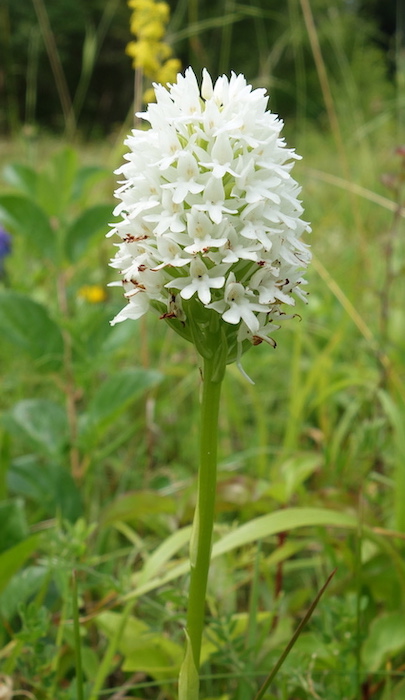
The rare white flowered variant of the Pyramdial Orchid Anacamptis pyramidalis var. albiflora is shown on the right below:
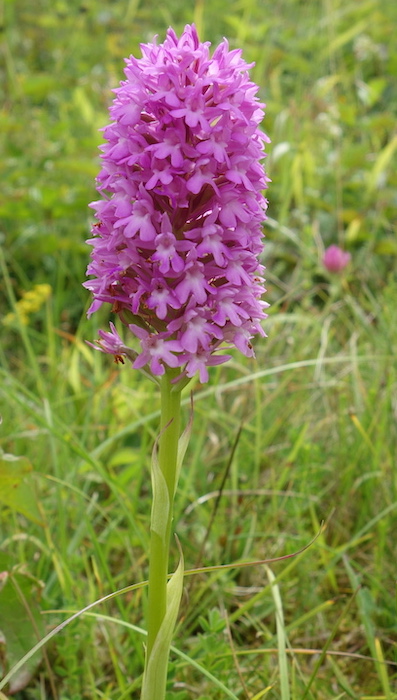
Genus: Anacamptis
Species: A. pyramidalis
Location: Aston Clinton Ragpits BBOWT reserve, Hinksey Hill Roundabout, Oxford.
Dates seen: mid July 2019
Habitat: Anacamptis pyramidalis requires a sunny spot typically on well drain chalk soils
Identification:
- the plant is 10 to 60cm tall
- 3 to 4 linear to lanceolate basal leaves
- flowers arranged in a distrinctive compact pyramidal shape
- flowers typically pink to purple, rarely white
Pollination: butterflys and moths
UK Classification: Least Concern
UK Distribution: Locally common in England, less common in Scotland
Cepalanthera
This genus have rhizomes rather than tubers. About 15 species are currently recognized, most of them native to Europe and Asia. Common names for some European species often include helleborine, though orchids in other genera such as Epipactis are also called helleborine.
White Helleborine (Cephalanthera damasonium)
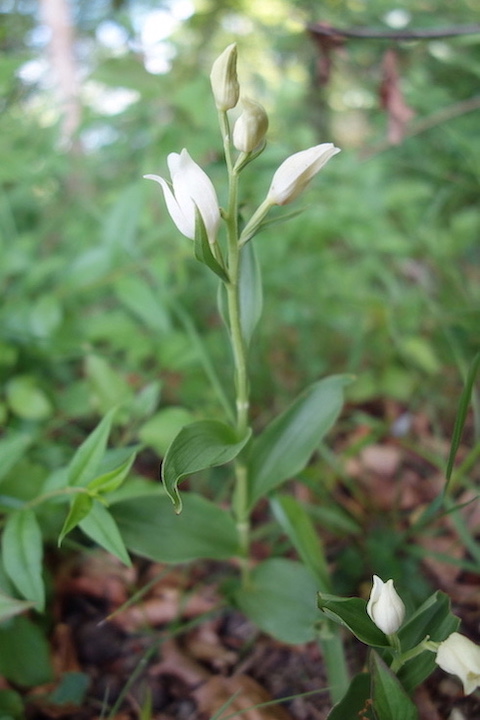
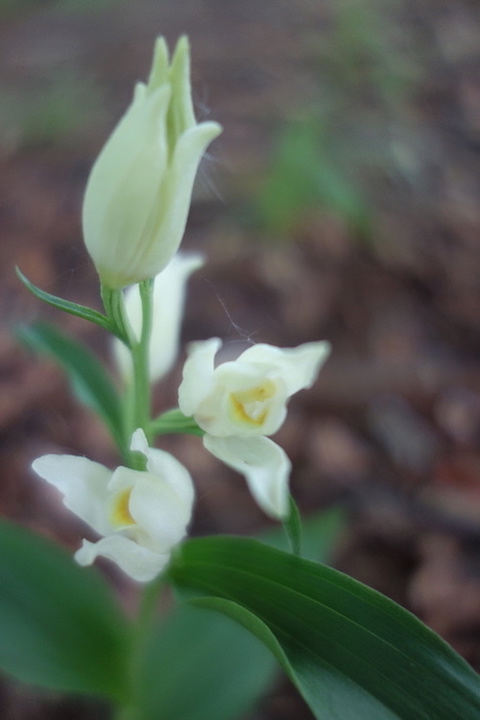
Genus: Cephalanthera
Species: C. damasonium
Location: Hartlock BBWOT reserve, Warburg BBOWT reserve
Dates seen: mid to late May 2019
Habitat: shaded margins of calcareous woodland, mostly beech woods
Identification:
- plant is 15 to 40cm tall
- 2 to 5 oval to lanceolate leaves
- leafy bracts
- flowers whitetish yellow and egged shaped, almost closed and erect, no scent
Pollination: largely self pollinated
UK Classification: Vulnerable
UK Distribution: Southern England, but not abundant
Red Helleborine (Cephalanthera rubra)
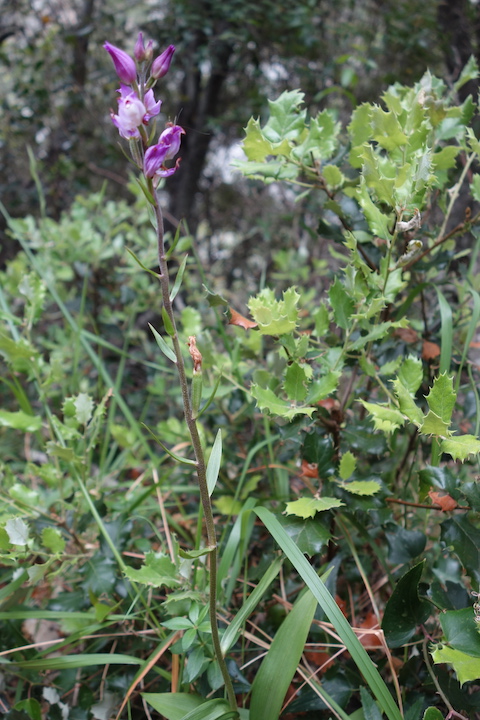
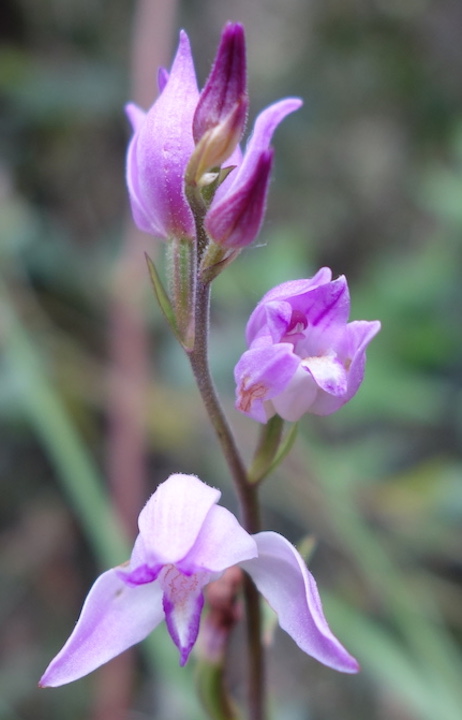
Genus: Cephalanthera
Species: C. rubra
Location: near Lebeña, Picos de Europa
Dates seen: early June 2019
Habitat: scrub in woodland magin, within steep limestone gorge
Identification:
- plant is 15 to 60cm tall, spindly stem with greyish hairs
- 2 to 8 narrow oval to lancelot leaves
- upper bracts shorter than flowers
- up to 20 flowers, slightly open, bright pink, spreading laterals, dorsal lobe curving over petals
- subsessile overy
Pollination: mostly autogamously
UK Classification: Critically Endangered
UK Distribution: Southern England, but not abundant
Coeloglossum
Coeloglossum is thought to have only one species, Coeloglossum viride, the frog orchid. Recent classifications regard Coeloglossum as part of the larger genus, Dactylorhiza, so that C. viride becomes Dactylorhiza viridis.
Frog Orchid (Coeloglossum viride)
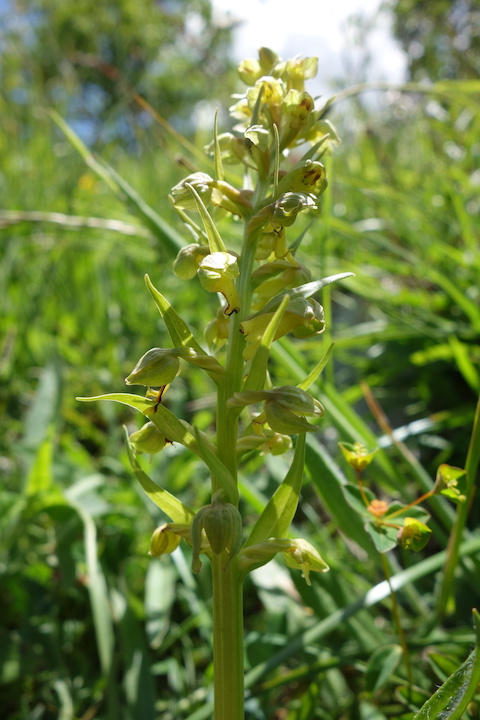
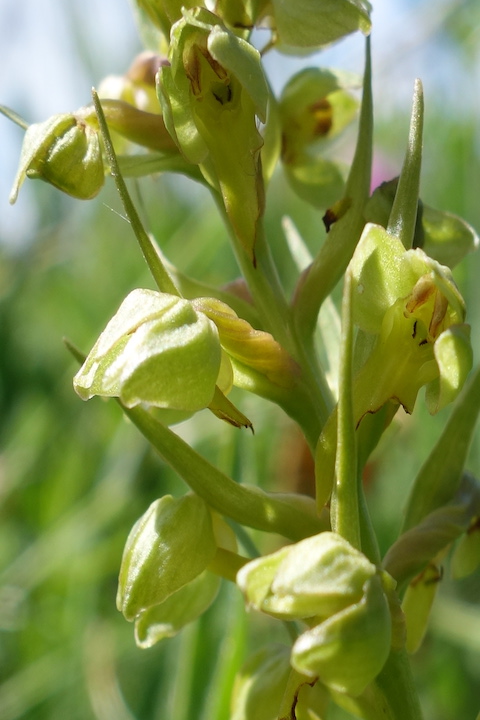
Genus: Coeloglossum
Species: C. viride
Location: Bejes, Picos de Europa
Dates seen: early June 2019
Habitat: damp meadow above 1000m, slightly acidic soils
Identification:
- plant is 5 to 15cm tall
- 3 to 5 leaves, unspotted, suberect
- bract legth exceeding flowers
- 5 to 25 flowers, oval-triangular sepals green, sometimes purple
- pendant like labellum, three lobes at tip
Pollination: bees and small wasps, or self-pollinated
UK Classification: Vulnerable
UK Distribution: UK wide, but not abundant
Dactylorhiza
Plants in the Dactylorhiza are hardy tuberous geophytes. They typically have long lanceolate leaves which are often also speckled. The flowers are typically white or shades of pink to red.
Common Spotted Orchid (Dactylorhiza fuchsii)
D. fuchsii is a widespread and abundant orchid with a distribution throughout temperate Europe. I came across the Common Spotted at my local nature reserve, Lye Valley, a tufa-forming valley-head alkaline spring fen. I also saw it at Homefield wood where various specimens started to emerge as of late May.
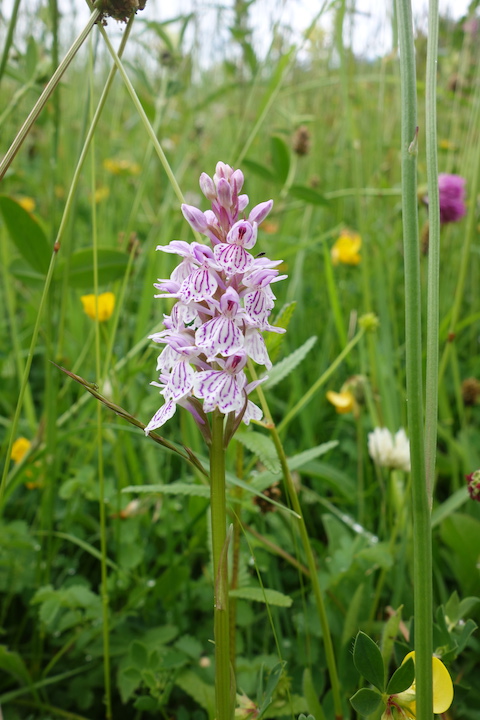
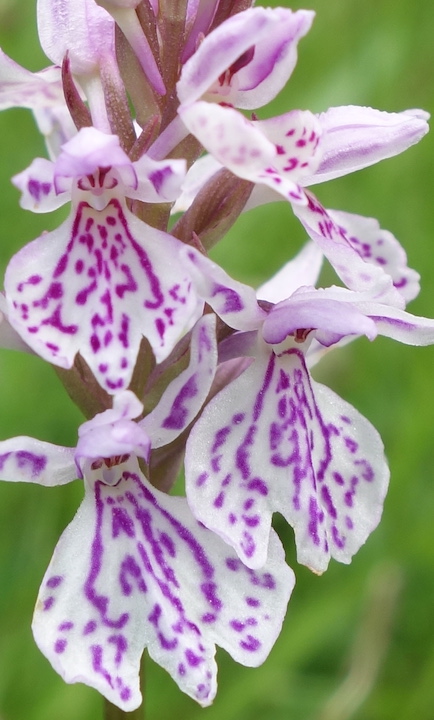
Genus: Dactylorhiza
Species: D. fuchsii
Location: Lye Vally, Homefield Woods
Dates seen: late May to July 2019
Habitat: highly variable: woodland, dry grassland, wet meadows, marshes, dune slacks and human-made habitats
Identification:
- height up to 65cm, green leaves, marked with solid dark spots
- flowers pink to pale white, lateral asymmetric sepals are horizontal, with lines and spots
- labellum divided into three lobes, central lobe longer and triangular
- mildly scented
Pollination: variety of insects
UK Classification: Least Concern
UK Distribution: UK wide, except the Scottish Highlands
Early Marsh Orchid (Dactylorhiza incarnata)
Generally found in wet meadows, calcareous marshes and sand-dunes, this is the most widespread of the marsh-orchids. There are five identified sub-species, which sometimes identification difficult. The best site for the Early Marsh that I found was at Pixey Mead, a SSSI, just north of Oxford. This ancient wet meadow had dozens of plants that were starting to flower as of late May. D. incarnate is similar to the Southern Marsh; but this is typically a larger plant, with larger flowers that are a darker pink.
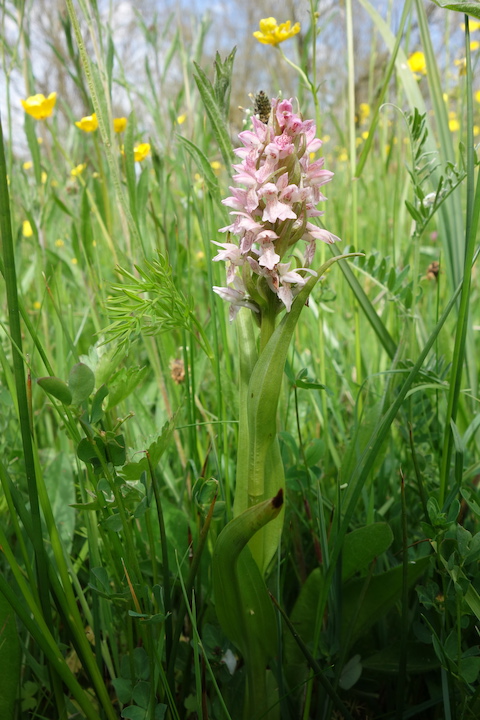
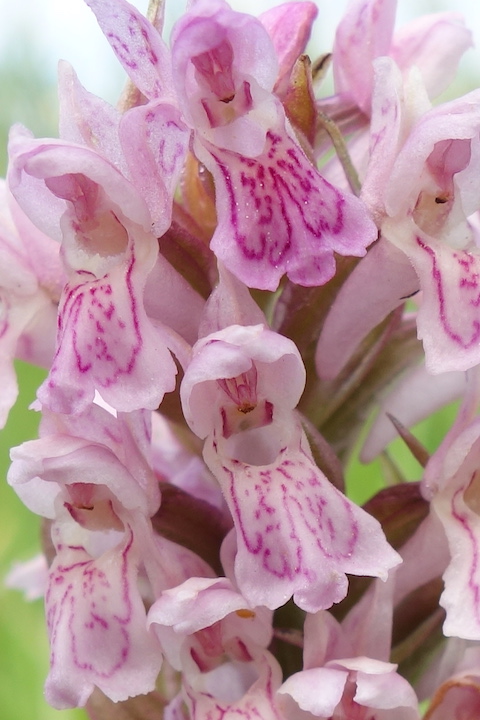
Genus: Dactylorhiza
Species: D. incarnata
Location: Pixey Mead
Dates seen: late May to June 2019
Habitat: wet (not improved) meadows and marsh that are alkaline
Identification:
- 4 to 8 unmarked, slender leaves with hooded tips
- flowers are flesh pink colour, bracts clearly exceed flowers
- the lateral sepals are held upwards, like donkey’s ears
- lip has three shallow lobes, with sides strongly bent downwards
- note there are five subspecies of incarnata
Pollination: variety of insects
UK Classification: Least Concern
UK Distribution: widely across UK
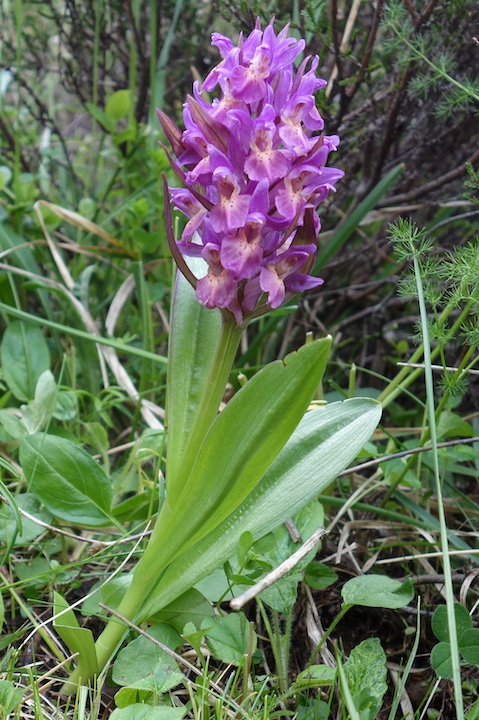
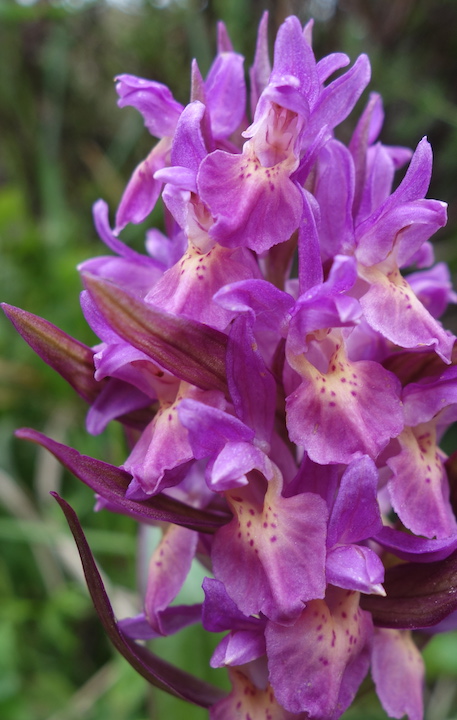
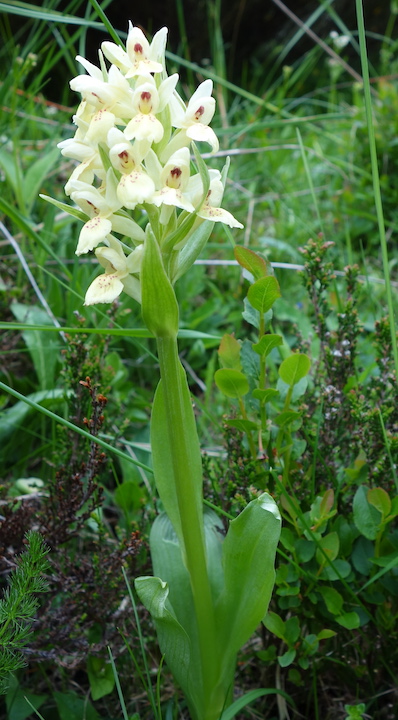
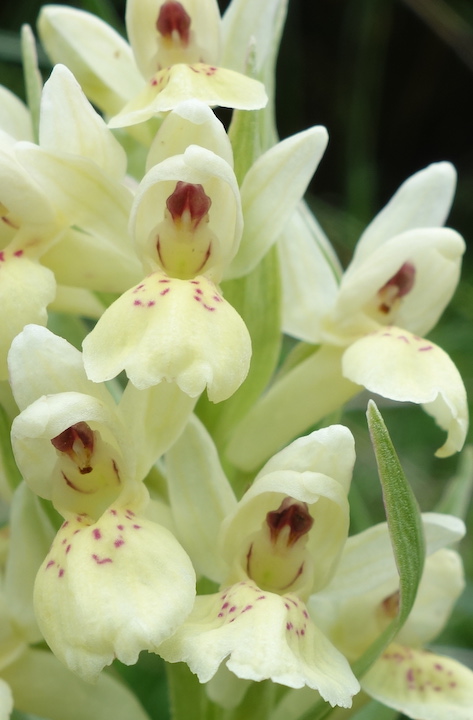
Elder Flowered Orchid (Dactylorhiza sambucina)
The red and orange variant:
The white and yellow variant:
Genus: Dactylorhiza
Species: D. sambucina
Location: Picos de Europa
Dates seen: early June 2019
Habitat: likes full sun, unimproved grassland, always in mountains upto 2,500m
Identification:
- 10 to 30cm tall, stem thick and hollowed out
- 4 to 7 lanceolate leaves
- flowers yellow or red
- lateral sepals erect, labellum trilobed and slightly convex
- elder-flower scented
Pollination: Not known.
UK Classification: NA. Classifed as Vulnerable in northern Spain.
UK Distribution: NA.
Heath spotted Orchid (Dactylorhiza maculata)
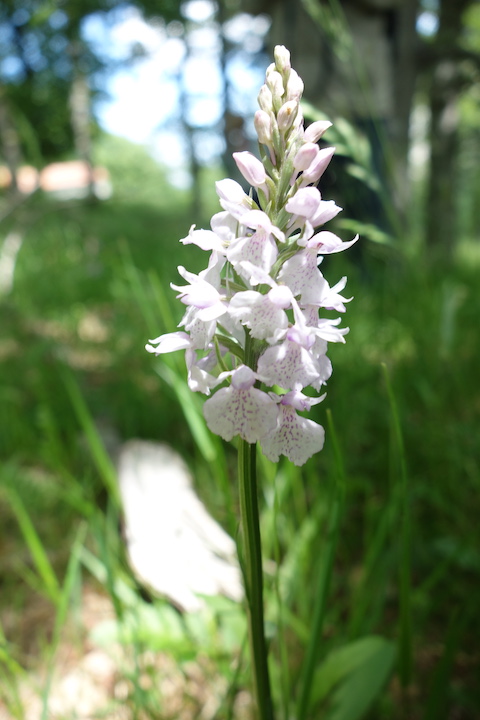
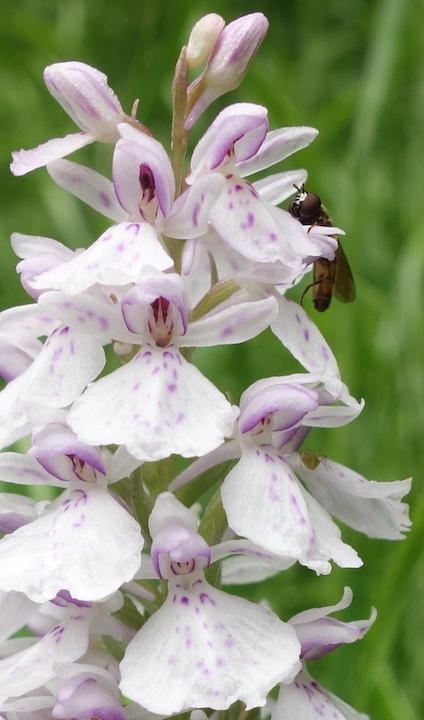
Genus: Dactylorhiza
Species: D. maculata
Location: Picos
Dates seen: early June 2019
Habitat: acid soils (unusually for UK species), heathland and marsh
Identification:
- 20 to 60cm tall, with 4 to 10 ten lanceolate leaves
- short bracts
- 15 to 50 pale white to pinkish flowers , lateral sepals
- labellum triloed to subentire, flat or slightly convex, with light purple spots
Pollination: bees and flies
UK Classification: Least Concern
UK Distribution: Widely distributed in the west and north of Britain. Less common in South East.
Southern Marsh Orchid (Dactylorhiza praetermissa)
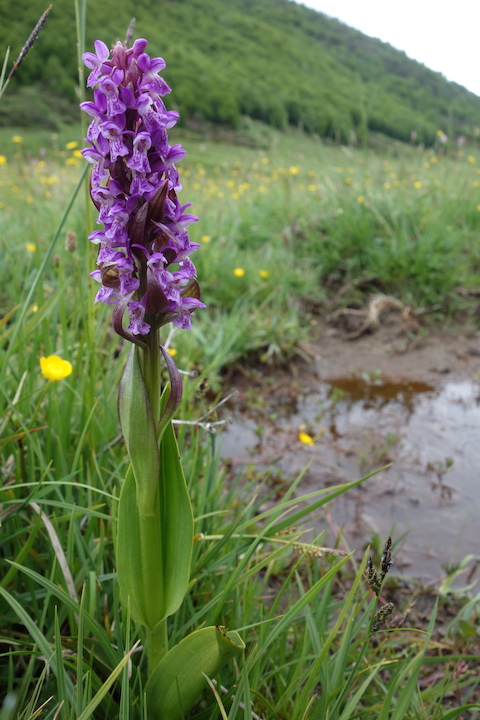
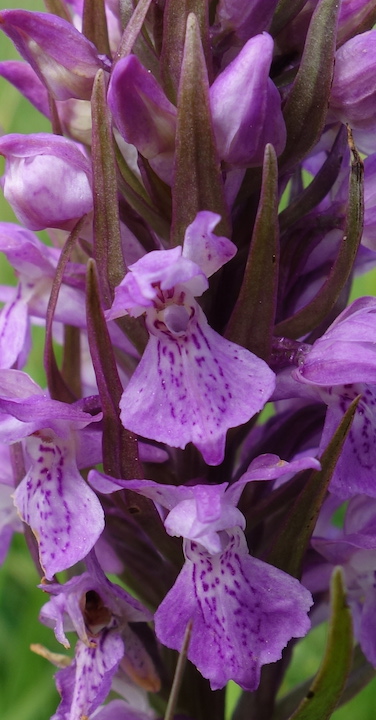
Genus: Dactylorhiza
Species: D. praetermissa
Location: Dry Sandford Pit BBWOT Reserve, Picos de Europa
Dates seen: late June 2019
Habitat: tolerates a wide range of soils. Prefers damp conditions
Identification:
- robust, upto 70cm tall
- upto 100 flowers, from pale lilac to dark magenta
- bracts not as long as early marsh orchid, large sheathing stem leaves
- flower lip is broad, often with downward pointing central spur
- upper lateral sepals are spreading, becomming erect
Pollination: Large Skipper butterflies have been observed
UK Classification: Least Concern
UK Distribution: Widespread in southern England, less common in south-east England
Sicillian Orchid (Dactylorhiza markusii)
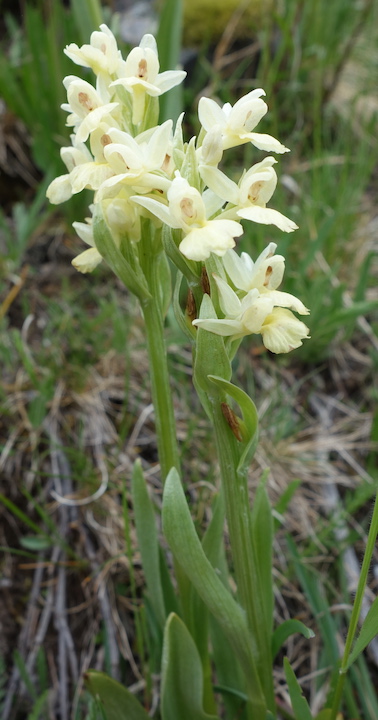
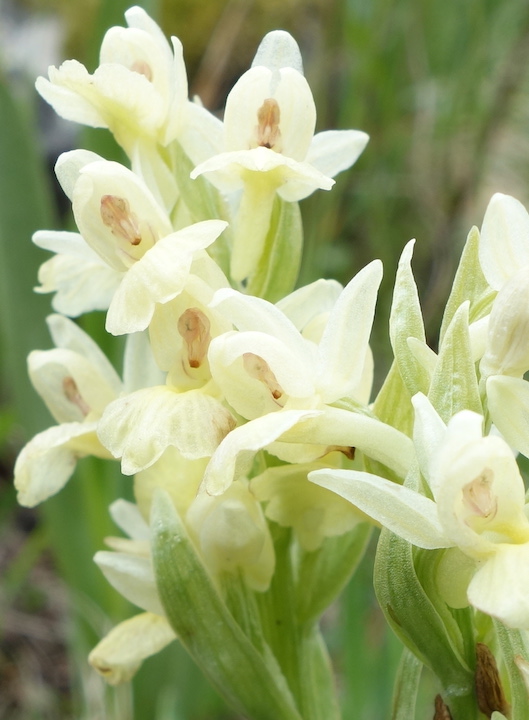
Genus: Dactylorhiza
Species: D. markusii
Location: Picos de Europa
Dates seen: early June 2019
Habitat: acidic soils and poor grass land, above 700m elevation
Identification:
- up to 40cm tall, bright green lanceolate leaves
- 10 to 40 flowers whiteish yellow flowers, inflorescence quite compact
- hood formed with petals, labellum brighter yellow than sepals and trilobed
Pollination: Bees
UK Classification: NA. Classified as Vulnerable to Critically Endangered in northern Spain.
UK Distribution: Not found in the UK.
Epipactis
Epipactis is a genus consisting of approximately 70 species. They orchids grow in open spaces in forests, in undergrowth, on calcareous soils and are often found in wet dune-slacks near the sea.
(Epipactis kleinii)
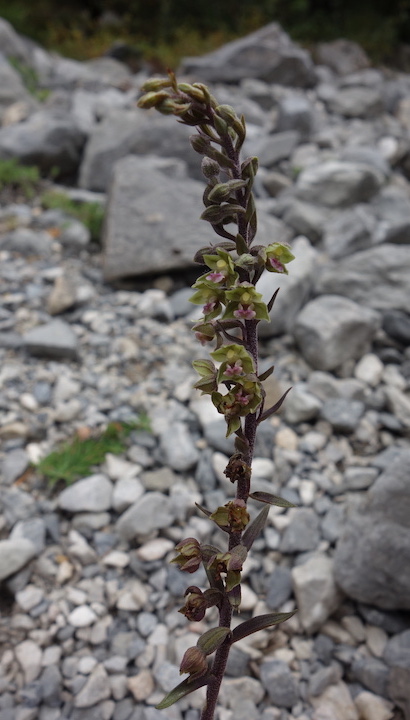
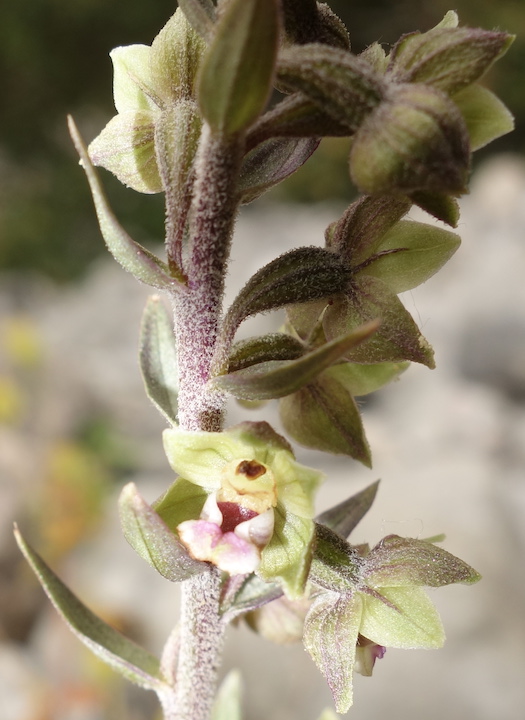
Genus: Epipactis
Species: E. kleinii
Location: Picos de Europa
Dates seen: early June 2019
Habitat: semi-shade on poor alkaline soils, above 700m elevation
Identification:
- up to 50cm tall, lanky. Long greyish-green leaves
- stem and leaves are hairy
- small 10 to 40 flowers along stem
- sepals and petals yellow-green , tinted purple
- labellum stained rose-purple inside
Pollination: self pollinated
UK Classification: NA
UK Distribution: NA. Seen in northern Spain
Broad Leaved Helleborine (Epipactis helleborine)
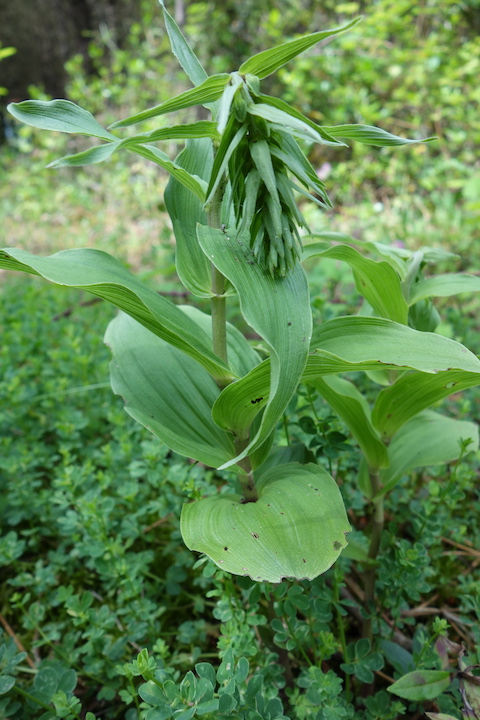
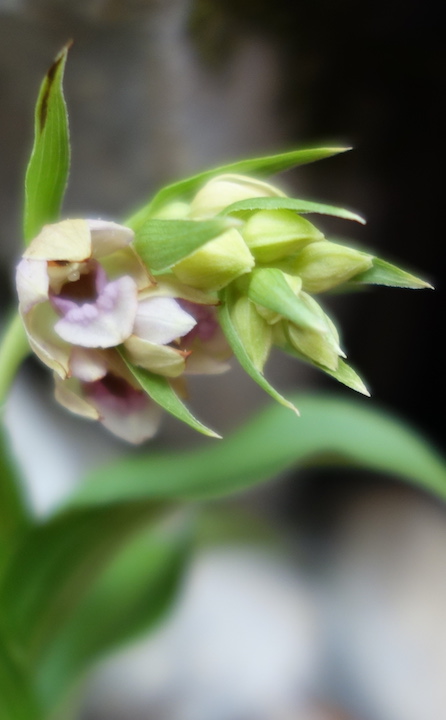
Genus: Epipactis
Species: E. helleborine
Location: Picos de Europa
Dates seen: early June 2019
Habitat: prefers alkaline soils, on the edges of woodland
Identification:
- tall - upto 90cm. Leaves are broad, strongly ribed and spiral up the stem
- upto 100 flowers, coloured green to brown, blunt sepals
- ovary strongly ribbed
Pollination: Ants and wasps
UK Classification: Least Concern
UK Distribution: widely distributed throughout England, Wales and central Scotland.
Marsh Helleborine (Epipactis palustris)
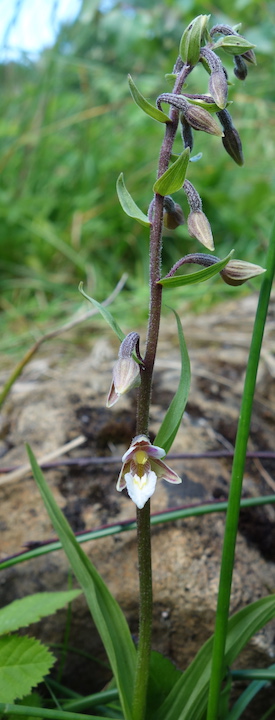
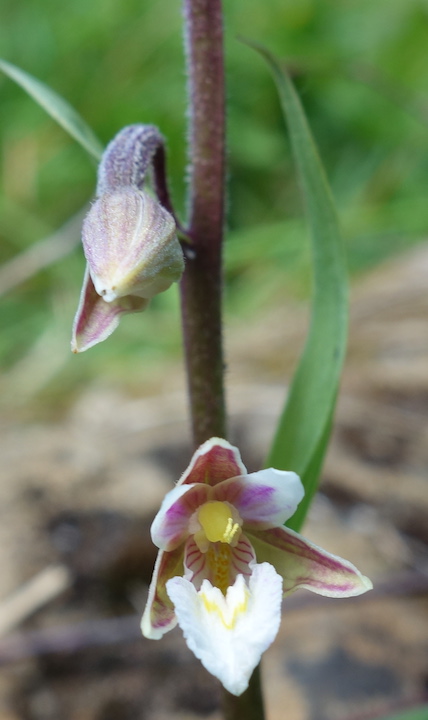
Genus: Epipactis
Species: E. palustris
Location: Dry Sandford Pit BBOWT Reserve
Dates seen: early June 2019
Habitat: Calcareous fens and marshes
Identification:
- up to 60cm tall, leaves are numerous and pointed
- sepals pointed, purple-brown, petals white with pink base
- broad white epichile with frilly edge, hypochile marked with parallel red veins
Pollination: honey bees, hoverflies and a small black wasp (Psen palustris)
UK Classification: Least Concern, but decreasing in most areas it is found.
UK Distribution: coastal East Anglia, southern England
Gymnadenia
The Gymnadenia genus contains 22 species which are typically found in damp meadows, fens and marshes.
Fragrant Orchid (Gymnadenia conopsea)
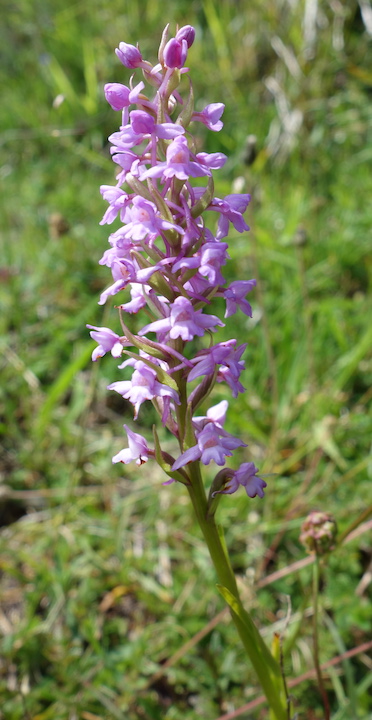
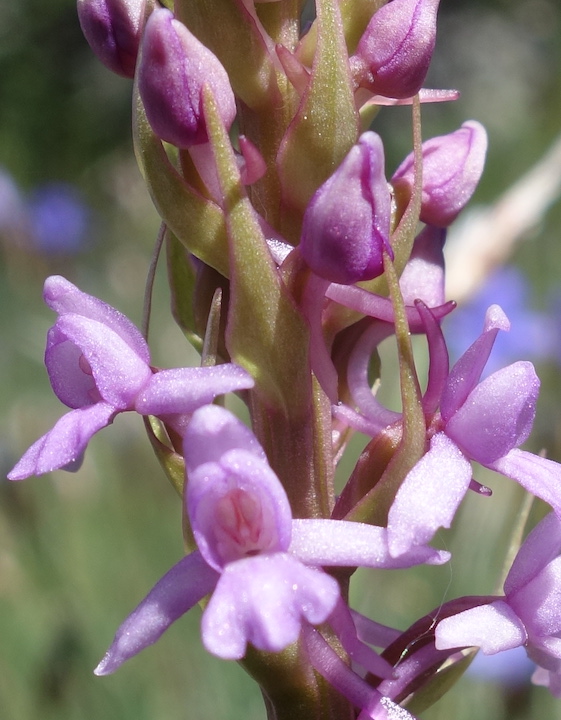
Genus: Gymnadenia
Species: G. conopsea
Location: Picos de Europa
Dates seen: early June 2019
Habitat: full sun, dry calcareous soils
Identification:
- slender plant, upto 60cm tall
- 5 to 12 erect lindear-lanceolated leaves
- upto 200 densley packed strongly scented pink flowers
- lateral sepals are narrow and droop down
- lip clearly divided into three lobes
Pollination: butterflys and day flying moths (six-spot burnet moth observed)
UK Classification: Least Concern
UK Distribution: locally abundant across the UK.
Himantoglossum
There are four species of this genus within Europe. They all have a central labellum with a central lobe that is much longer than the lateral lobes.
Lizard Orchid (Himantoglossum hircinum)
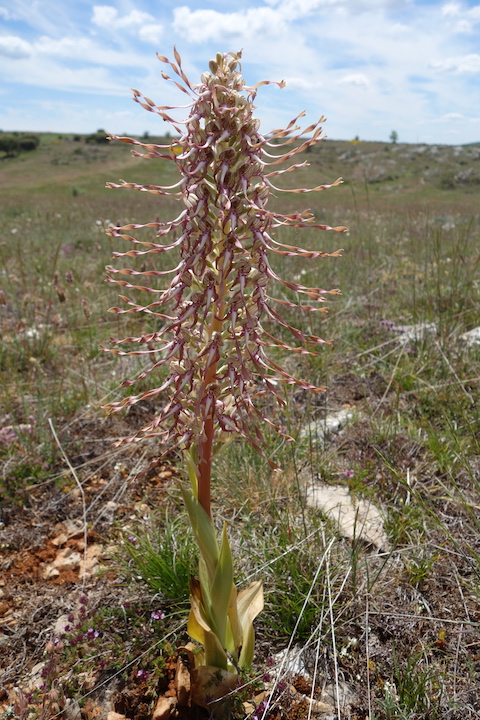
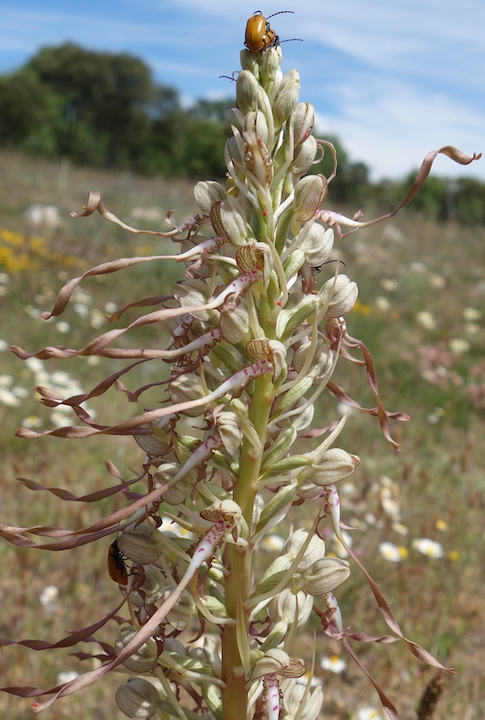
Genus: Himantoglossum
Species: H. hircinum
Location: Picos de Europa
Dates seen: early June 2019
Habitat: chalk grassland and calcareous sand dunes, sunny aspect
Identification:
- upto 70cm tall, large plant
- upto 80 flowers, upto five leaves
- sepals and upper petals form tight grey-green hood, brown parallel lines on inside
- lip is trilobed, long curly lateral lobes, very long centeal lobe (c.5cm), tinged with green and purple
- the flowers smell of goats (ref. Dr Andrew Lack)
Pollination: solitary bees and small insects
UK Classification: Near Threatened
UK Distribution: restricted to southern England (mostly golf courses!)
Neottia
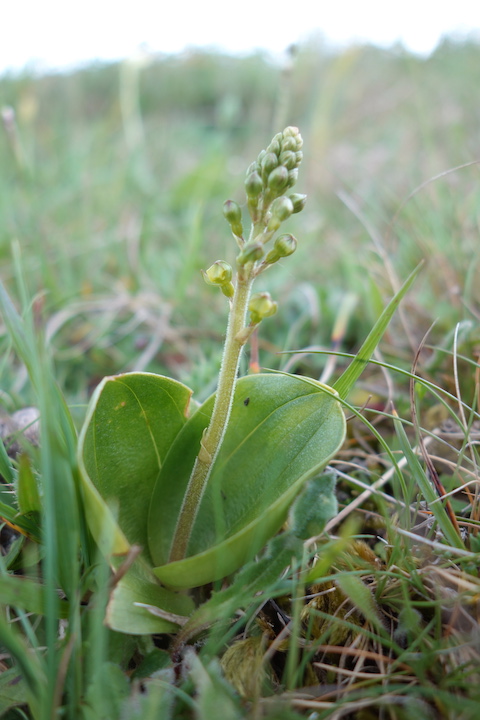
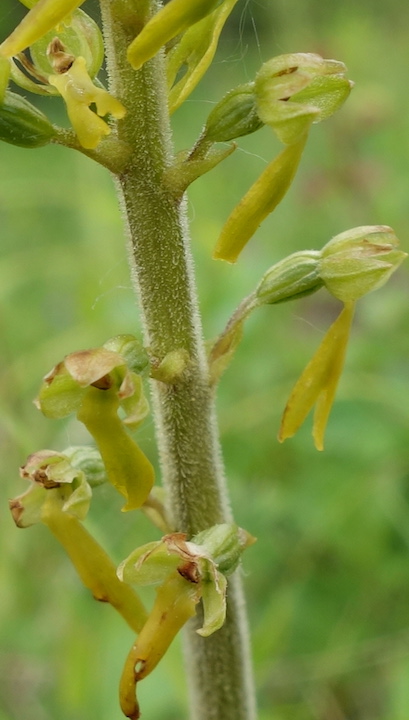
Common Twayblade (Neottia ovata)
Genus: Neottia
Species: N. ovata
Location: Hartslock, Warburg, Homefield Woods
Dates seen: late May to early June 2019
Habitat: widespread - grassland, scrub, deciduous woodland
Identification:
- stem entirely green, 20-60cm tall, whitetish hairs
- two large paired leaves at ground level, with distinct veins
- bracts 3 to 5cm long
- 20 to 80 flowers, yellowy-green, sepals and petals oval curving into loose hood
- labellum pendant, 7 to 15mm long, tip divided into two elongated lobes
- globular ovary
Pollination: pollinated by numerous insects (due to abundant nectar)
UK Classification: Least Concern
UK Distribution: Throughout UK
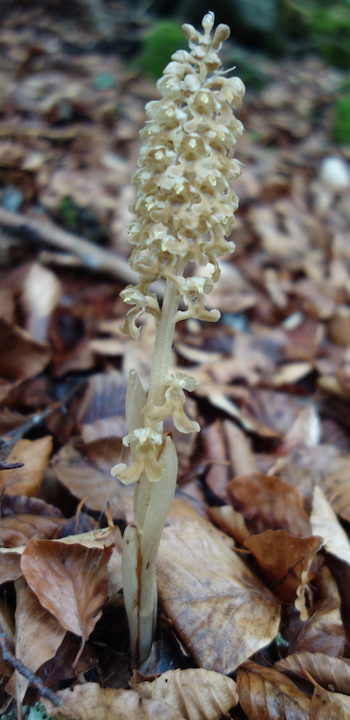
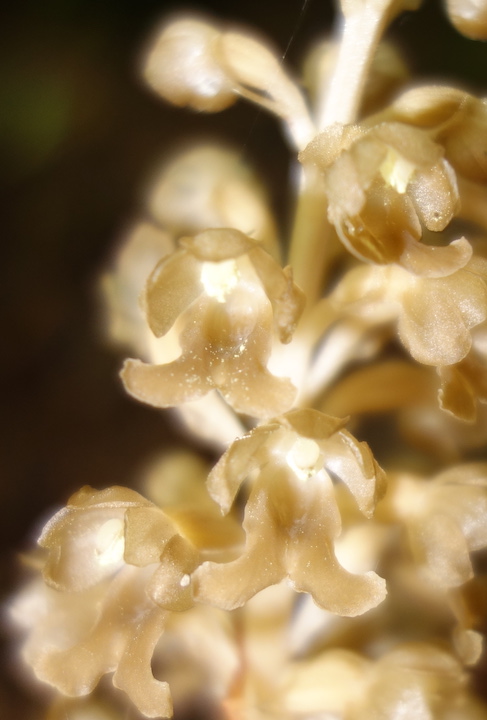
Birds Nest Orchid (Neottia nidus-avis)
The Bird’s-nest orchid is leafless and with the green chlorophyll of photosynthesising plants. The Bird’s-nest grows as a parasite on the roots of trees, gaining its nutrients from its host. Usually found in woodland, particularly under Beech trees,
Genus: Neottia
Species: N. nidus-avis
Location: Homefield Woods and Picos de Europa
Dates seen: May 2019
Identification:
- the rhizome has short fleshy roots, resembling a birds nest
- honey brown in colour, with stem upto 50cm tall
- has upt 100 flowers, short petals and sepals, forming a hood above the lip
- the plant is saprophytic and lacks chlorophyll
Habitat: Prefers heavy shaded woodland on chalk soils, covered in leaf mould. Typically amongst mature Beech trees
Pollination: small flys and self-fertilisation
UK Classification: Near Threatened
UK Distribution: Southern England
Nigritella
This is a small genus of plants. There are thought to be nine species, all of which are confined to alpine zones.
Black Vanilla Orchid (Nigritella nigra)
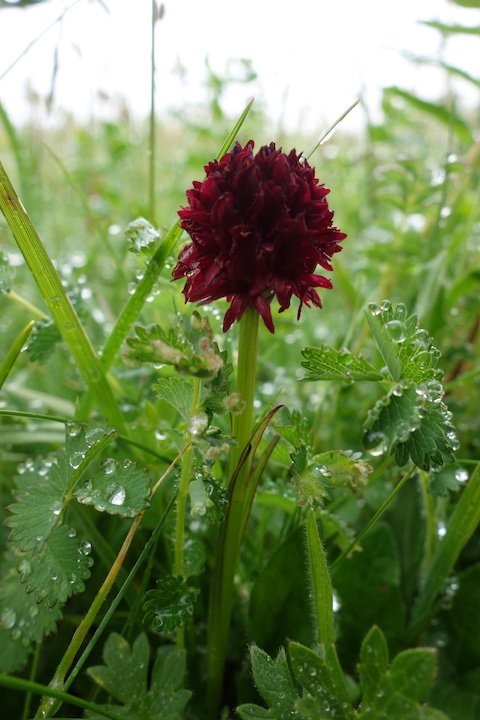
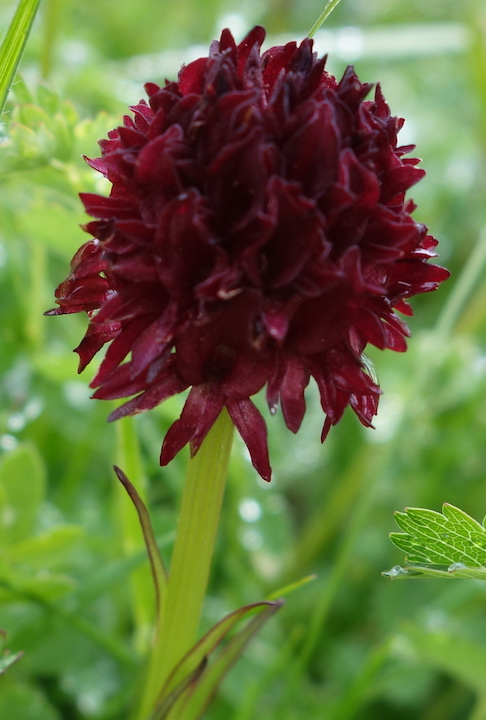
Genus: Nigritella
Species: N. nigra
Location: Picos de Europa
Dates seen: June 2019
Identification:
- plant is 5 to 30cm high, upto 11 linear leaves
- compact influorescence, numerous small dark purple flowers
- strong spicy vanilla scent
Habitat: apline praries, above 1000m. Full sun, alkaline soils
Pollination: no data
UK Classification: NA
UK Distribution: NA
Ophrys
This is a large genus. They specialise in reproducing through pseudocopulation. The type species is the fly orchid, Ophrys insectifera.
Bee Orchid (Ophrys apifera)
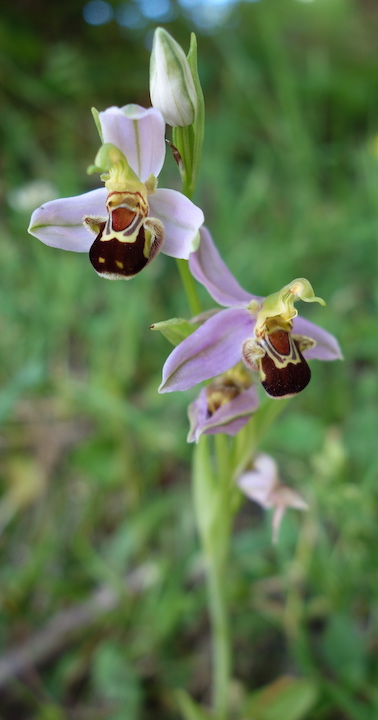
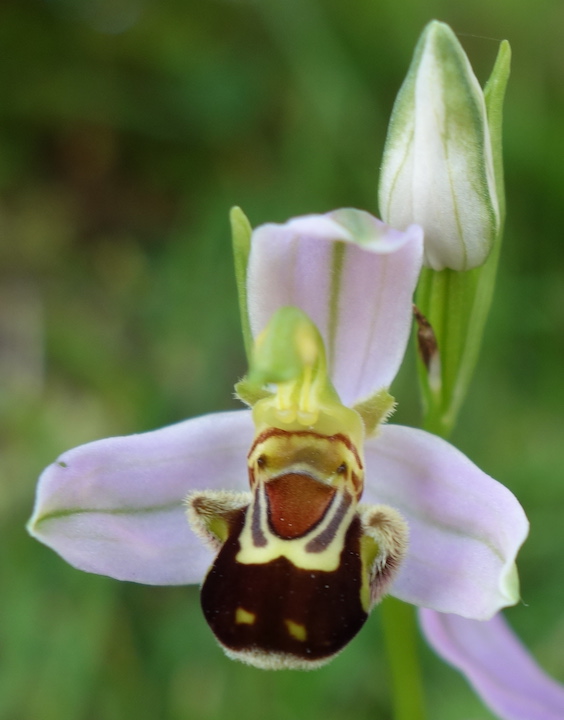
Genus: Ophrys
Species: O. apifera
Location: Homefield Woods
Dates seen: June 2019
Identification:
- stem upto 50cm tall, upto six basal leaves
- upto seven flowers that resemble a bumblebee
- three erect pink sepals, each with a green vein
- trilobed lip, velvety brown, golden at the base
- column in the centre of the flower have two large pollinia
Habitat: Chalk-grassland, meadows and dunes
Pollination: bee genera Andrena and Eucera
UK Classification: Least Concern
UK Distribution: Thoughtout England and coastal Wales
Fly Orchid (Ophrys insectifera)
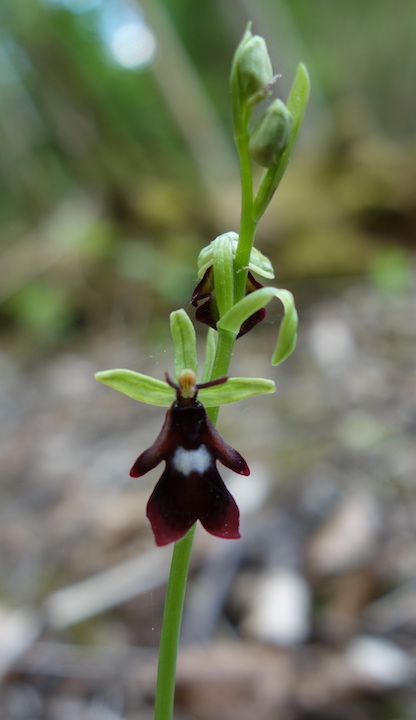
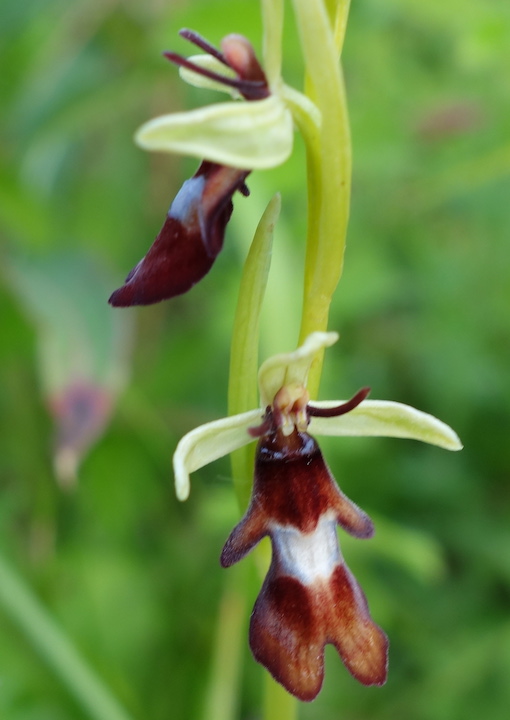
Genus: Ophrys
Species: O. insectifera
Location: Homefield Woods, Warburg
Dates seen: late April to May
Identification:
- spindly stem upto 60cm tall, upto two small leaves
- upto ten well spaced flowers, three pointed sepals, yellow-green
- upper petals look like antennae, lip is long with rounded lateral lobes
- lip is rich brown, with iridescent blue band
Habitat: favours damp, alkaline, unimproved soil. Found growing in beech woodlands, on forest path.
Pollination: plant secretes sex pheromones that attract male Digger Wasps.
UK Classification: Vunerable
UK Distribution: England
Woodcock Orchid (Ophrys scolopax)
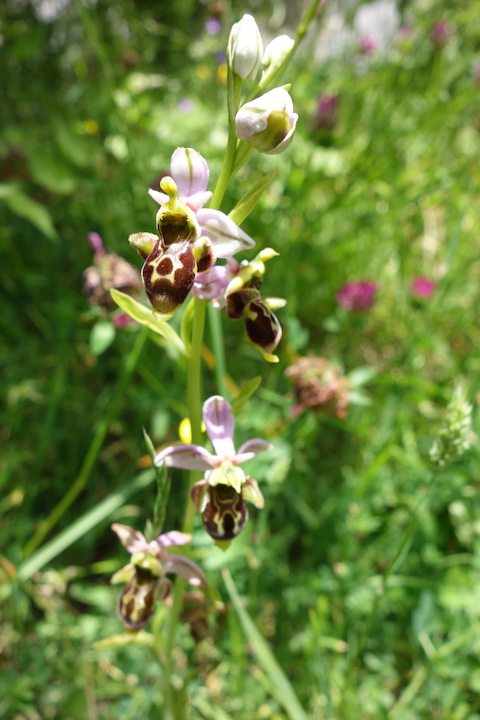
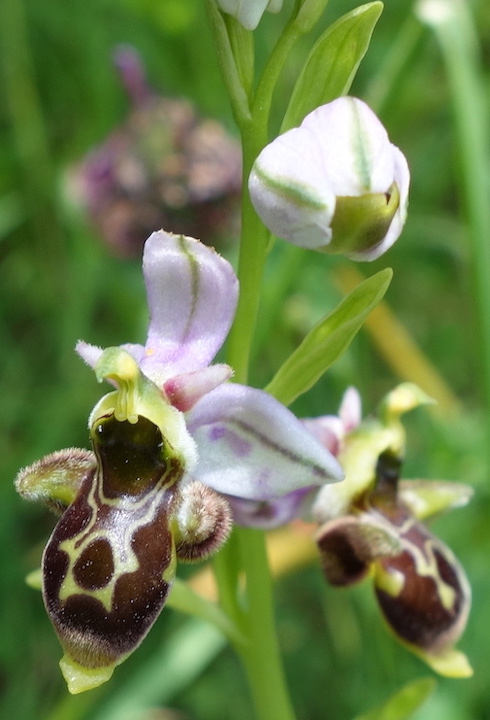
Genus: Ophrys
Species: O. scolopax
Location: Picos de Europa
Dates seen: early June
Identification:
- upto 40cm tall, upto 12 flowers
- sepals white to pink, central green vein, oval edges
- narrow and short elongate petals
- labellum hanging, velvety brown to blackish purple with yellow central lobe
- thick H or X shape covering the lobe, lateral lobes very hairy
- stout column with central pollimia
Habitat: full sun on alkaline soils, fallow fields or scrub
Pollination: no data
UK Classification: N/A
UK Distribution: N/A
Early Spider Orchid (Ophrys sphegodes)
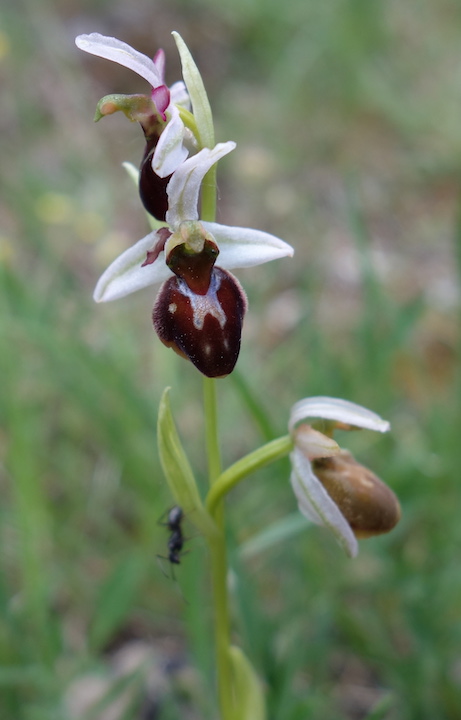
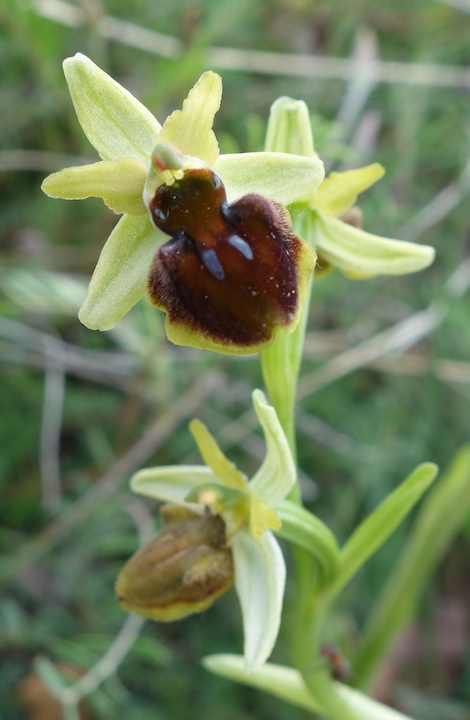
Genus: Ophrys
Species: O. sphegodes
Location: Picos de Europa
Dates seen: early June
Identification:
- upto 20cm tall, four broad basal leaves
- flower resembles flat hairy spider
- large oblong sepals, yellow-green. Two upper petals, strapped shaped
- central lobe is large and convex, velvety and rich brown with blue/grey H in the centre
- two lateral lobesare golden brown furry humps, like shoulders
- stout column, with pouch either sides like spider’s eyes
Habitat: closely grazed chalk grassland
Pollination: solitary bees
UK Classification: Least Concern, though declining due to grazing management
UK Distribution: coastal areas of southen England
Yellow Bee Orchid (Ophrys lutea)
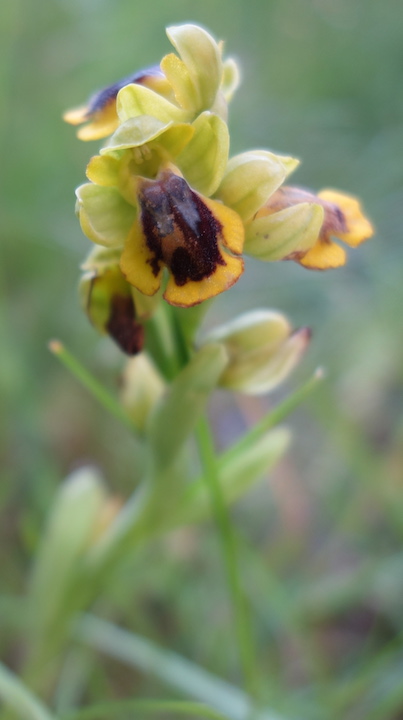
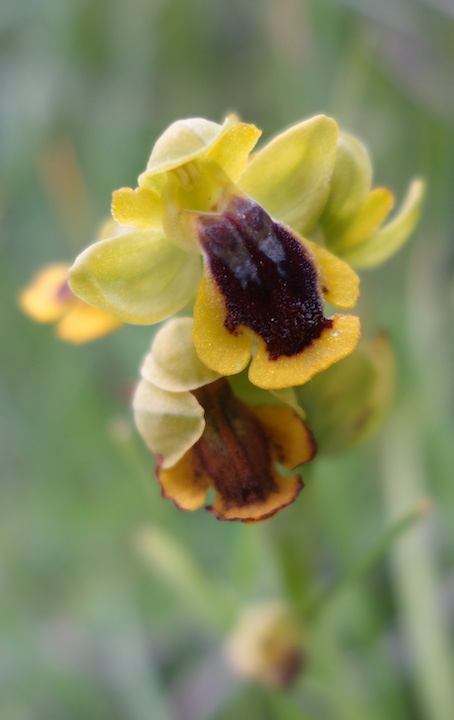
Genus: Ophrys
Species: O. lutea
Location: Picos de Europa
Dates seen: early June
Identification:
- upto 30cm tall plant, upto six large flowers
- sepals yellowish-green
- labellum trilobed, light orange brown centre, bright yellow margin
- lateral lobes bright yellow
Habitat: full sun, alkaline dry soils and grassland
Pollination: No data
UK Classification: N/A
UK Distribution: N/A
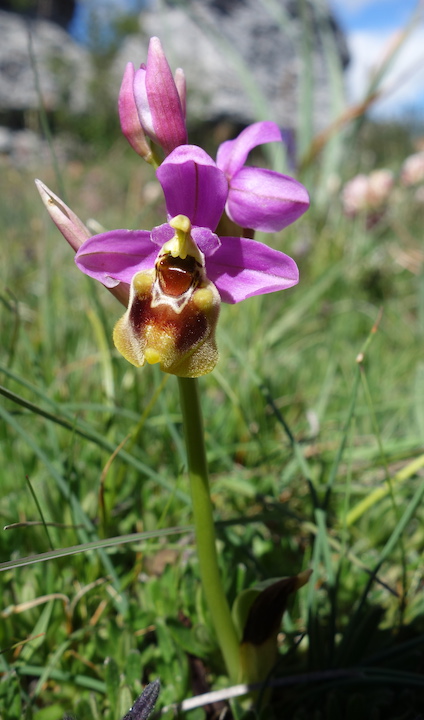
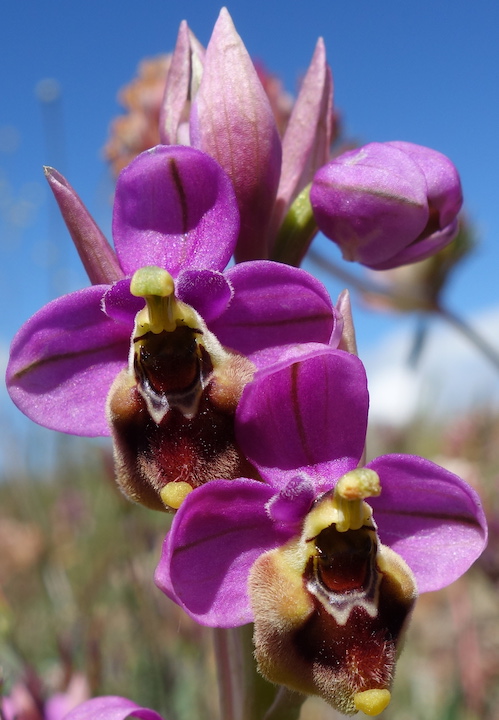
Sawfly Orchid (Ophrys tenthredinifera)
Genus: Ophrys
Species: O. tenthredinifera
Location: Picos de Europa
Dates seen: early June
Identification:
- upto 30cm tall, 4 to 9 oval-lanceolate leaves
- sepals oval-rounded, purple to pink.
- labellum is trapezoidal, deep brown to red, with bright yellow margin
- bright green-yellow column, contains pollinia
Habitat: full sun to shade. Likes alkaline soils, grassland upto 1800m
Pollination: various hymenoptera
UK Classification: NA
UK Distribution: NA
Orchis
The genus name is derived from the ancient greek meaning testicle. This is related to the paired subterranean tuberoids common to all species within the genus.
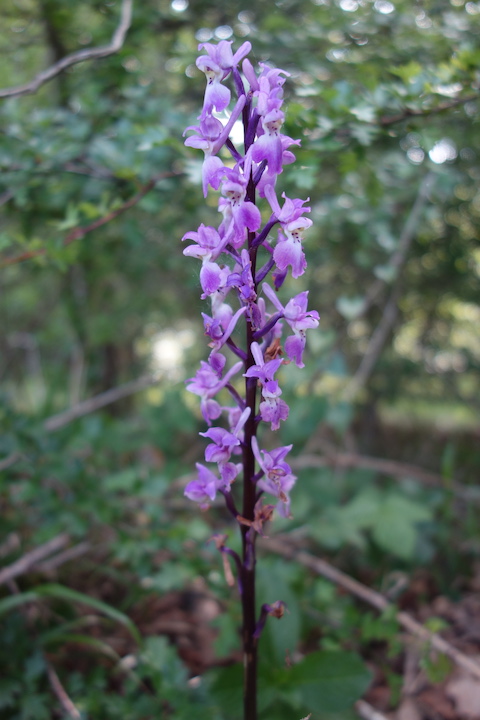
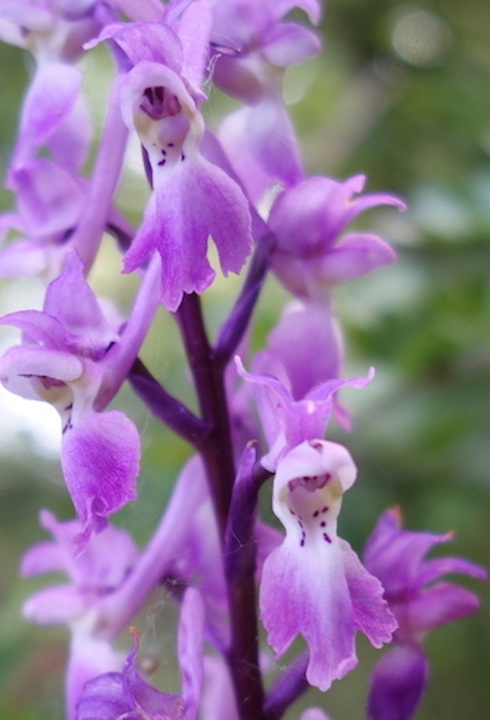
Early Purple Orchid (Orchis mascula)
Sub-family: Orchidoideae
Genus: Orchis
Species: O. mascula
Location: Sydlings Copse
Dates seen: late April to early May
Identification:
- Height upto 60cm, with six to eight dark spotted basal leaves
- 20-50 pinkish-purple flowers, sepals spread upwards
- broad trilobed lip with, centre of which is marked with dark spots
Habitat: neutral to calcareous soils, prefers woodland margin
Pollination: buff-tailed bumblebees and solitary bees
UK Classification: Least concern
UK Distribution: Widespread throughout the UK
Lady Orchid (Orchis purpurea)
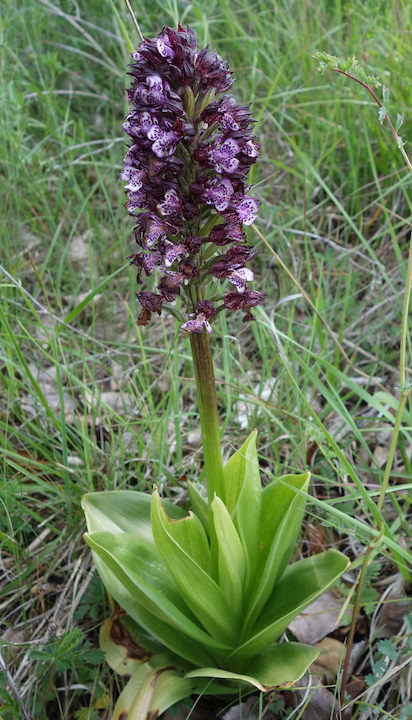
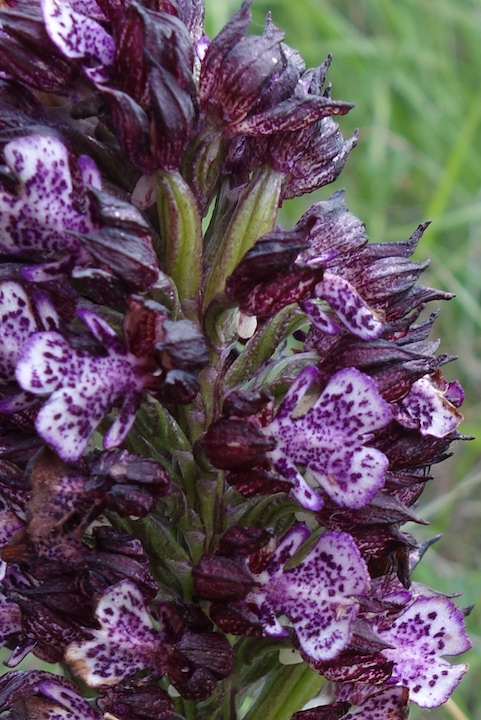
Genus: Orchis
Species: O. purpurea
Location: Hartlock BBWOT reserve
Dates seen: mid to late May 2019
Identification:
- upto 100cm tall, upto five broad leaves
- upto 50 large flowers in a dense spike
- sepals and upper petals form a broad hood of dark red, which forms a Lady’s bonnet
- broad three-lobed white lip is shaped like a womans dress, two narrow side lobes forming the arms
Habitat: open beech woodland, rarely in grassland
Pollination: the Digger Wasp Odynerus parietus
UK Classification: Least Concern, though nationally scarce
UK Distribution: Southern England (Oxfordshire and Kent)
Monkey Orchid (Orchis simia)
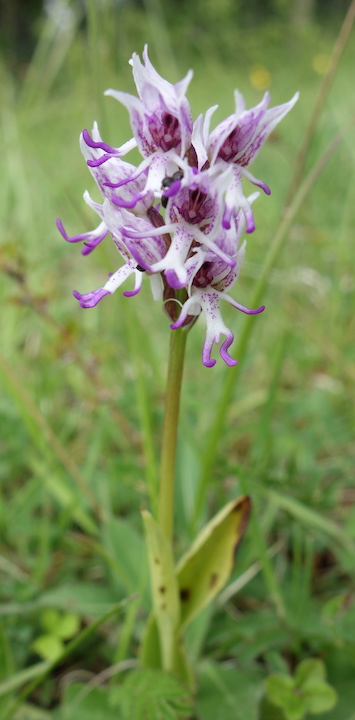
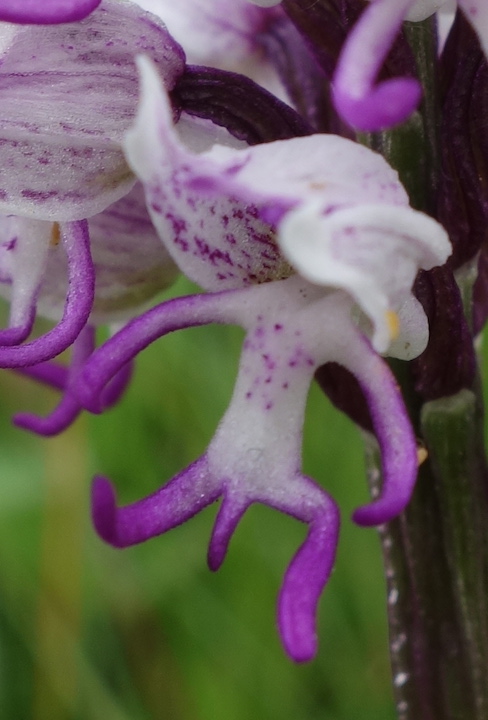
Genus: Orchis
Species: O. simia
Location: Hartlock BBWOT reserve
Dates seen: mid to late May 2019
Identification:
- upto 30cm tall, three to four basal leaves
- flower spike opens from the top downwards
- sepals and petals form a pointed hood, white in colour
- lip has four pinkish narrow lobes; the paws and tail of the monkey
Habitat: open well drained and chalky soils, sunny south facing grassland
Pollination: short-tonuged bees and Large White butterflies
UK Classification: Vulnerable
UK Distribution: Southern England, three known sites
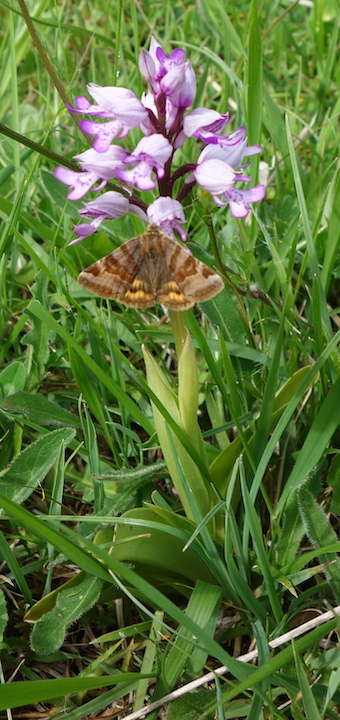
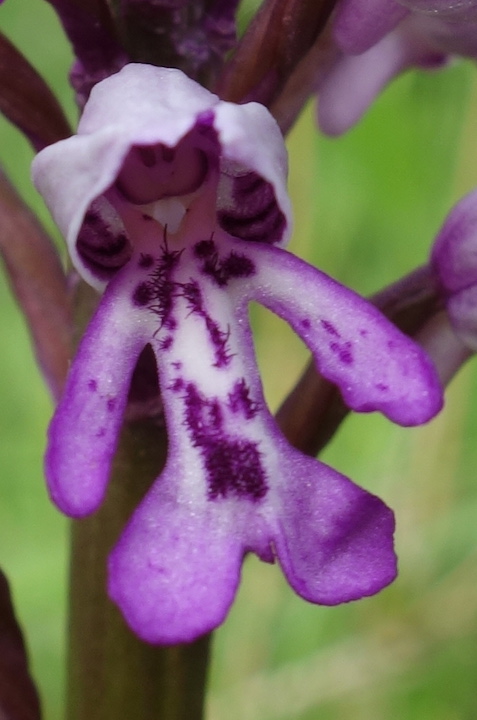
Military Orchid (Orchis militaris)
Genus: Orchis
Species: O. militaris
Location: Homefield Woods
Dates seen: early May 2019
Identification:
- upto 60cm tall, upto five broad basal leaves, small pinkish bracts
- normally around 30 whote to lilac flowers, sepals and upper petals form a distinctive hood
- long pinkish lip, line of mauve coloured hairs forming ‘soldiers buttons’
- two long side lobes forming ‘arms’, with lip bottom divided into two square lobes
Habitat: chalk grassland, along the edge of broad-leaved woodland
Pollination: solitary bees and day flying moths; see picture above of Burnet Companion moth (Euclidia glyphica) pollinating Orchis militaris.
UK Classification: Vulnerable
UK Distribution: four known sites in the UK.
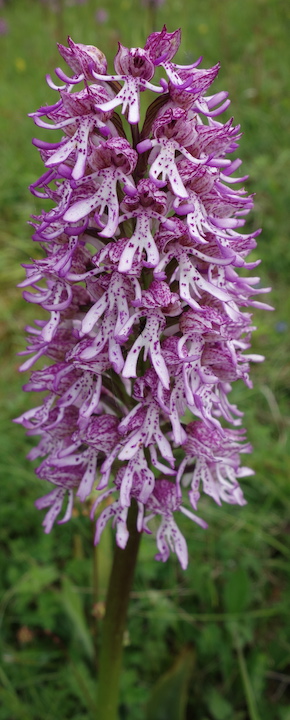
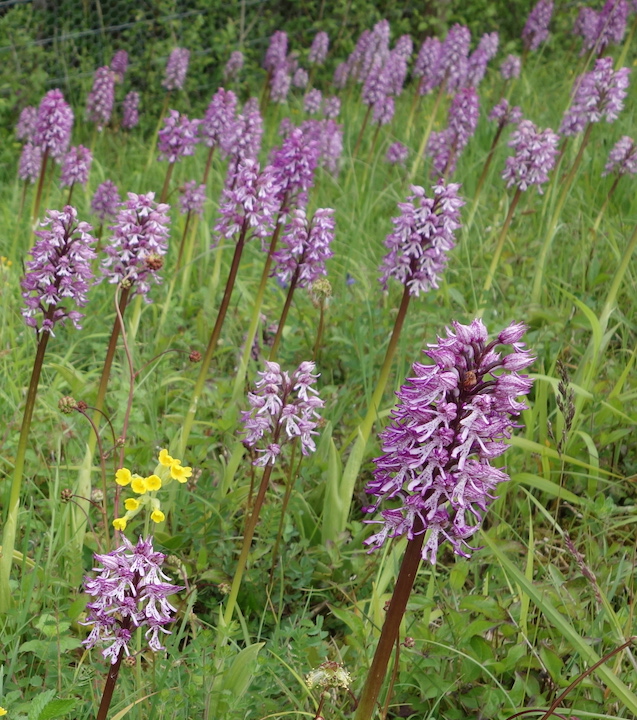
Lady x Monkey Orchid (Orchis x angusticrucis)
Genus: Orchis
Species: Orchis x angusticrucis ( sym. O.purpurea x O.simia)
Location: Hartslock BBWOT reserve
Dates seen: early May 2019
Identification:
- tall and vigourous, typically more flowers than parent species
- the ‘tail’ from the Monkey Orchid is much shorter in the Hybrid
- the two central lobes of the Lady orchid are much thinner in the Hybrid, more like legs
Pollination: no data
Habitat: chalk grassland, sunny aspect, edge of beech woodland
UK Classification: no data.
UK Distribution: one site (Hartslock)
Pink Butterfly Orchid (Orchis papilionacea)
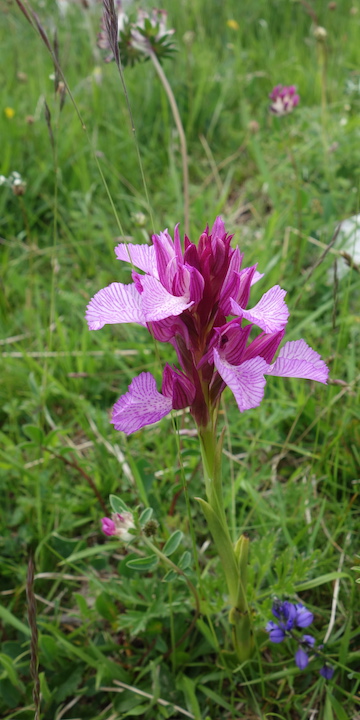
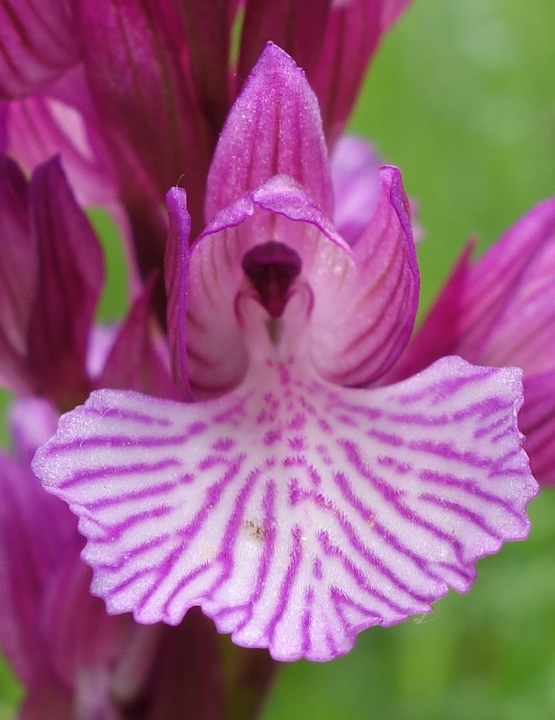
Genus: Orchis
Species: O. papilionacea
Location: Picos de Europa
Dates seen: early June 2019
Identification:
- upto 40cm tall, upto 9 linear to lanceolate basal leaves
- sepals and petals forming loose pink hood
- wide labellum , marked with long pink lines and dashes
Pollination: hymenopterans
Habitat: limestone grassland meadow, full sun, above 700m
UK Classification: NA
UK Distribution: NA
Green-winged Orchid (Orchis morio)
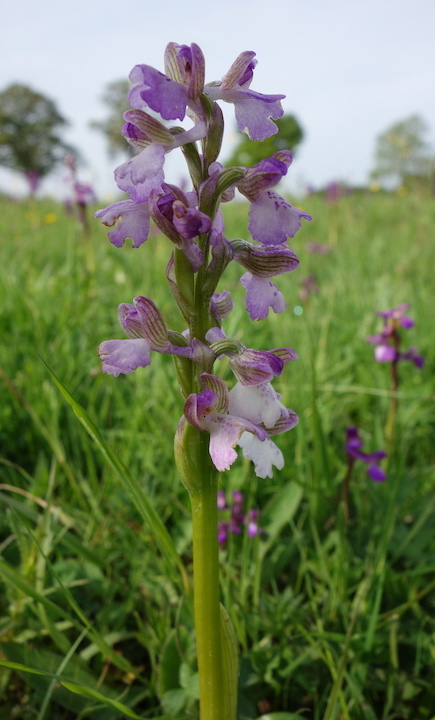
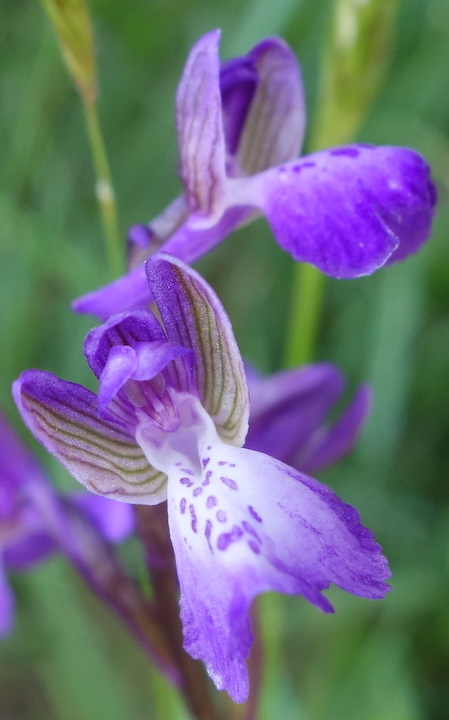
Genus: Orchis
Species: O. morio
Location: Bernwood Meadows
Dates seen: early May 2019
Identification:
- upto 15cm, eight basal leaves, purplish bracts
- upto 12 flowers varying from light lilac to purple
- lateral sepals marked with broad green veins
- broad trilobed lip, with shorter central lobe
- centre of the lip is marked with purple flecks
Pollination: red-tailed bumblebee
Habitat: unimproved meadow, slightly acidic
UK Classification: Near Threatened
UK Distribution: coastal Wales and South East England
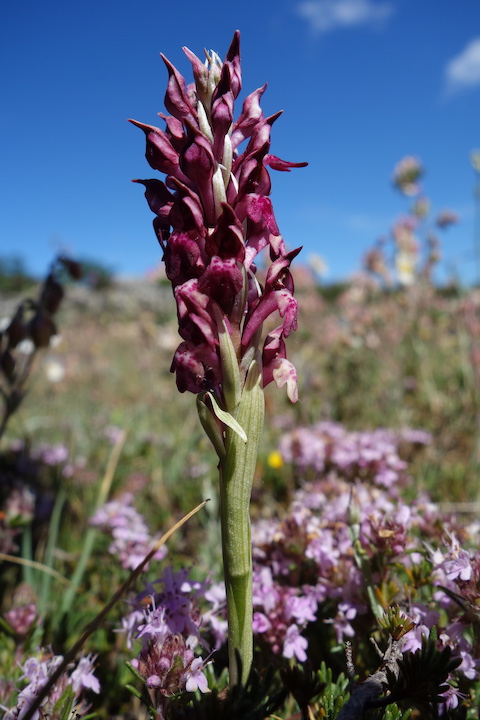
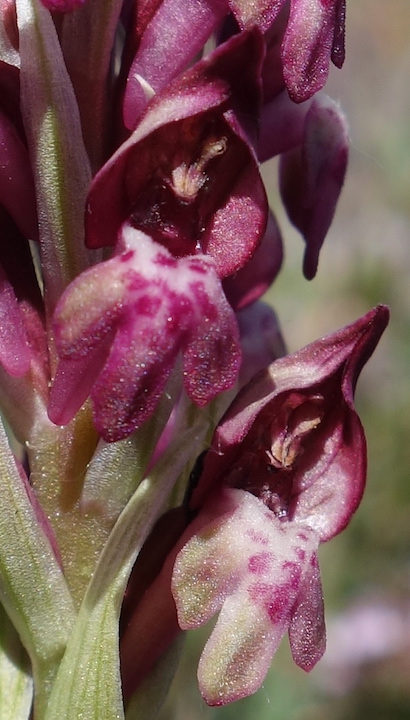
Bug Orchid (Orchis coriophora)
Genus: Orchis
Species: O. coriophora
Location: Picos
Dates seen: early June 2019
Identification:
- upto 40cm tall, 4 to 10 basal linear-lanceolate leaves
- bracts green with red edges, exceeding flower ovary
- sepals and petals form narrow hood
- numerous flowers, deep garnet coloured - smelling of bed-bugs
- labellum fleshy and trilobed
Habitat: impoverished grassland, full sun
Pollination: no data
UK Classification: NA
UK Distribution: NA
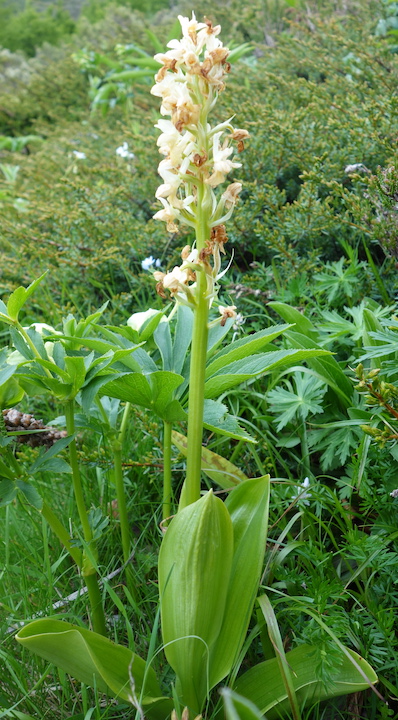
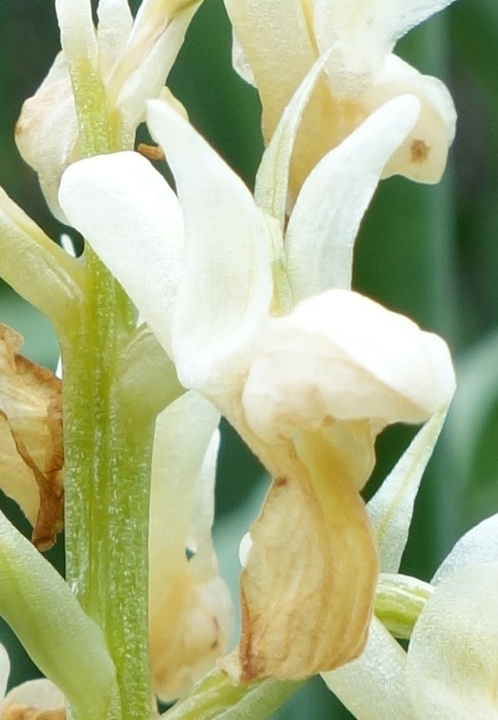
Pale-flowered Orchid (Orchis pallens)
Genus: Orchis
Species: O. pallens
Location: Picos de Europa
Dates seen: early June 2019
Identification:
- upto 40cm tall, four basel leaves forming a rosette
- upto 30 pale yellow flowers, lateral sepals are vertical
- labellum is wide with three lobes, middle lobe wider than laterals
Habitat: alpine pastures, edge of woodland, semi-shade
Pollination: no data
UK Classification: NA
UK Distribution: NA
Man Orchid (Orchis anthropophora)
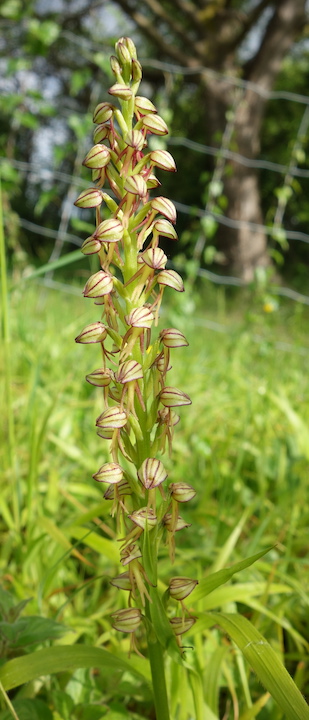
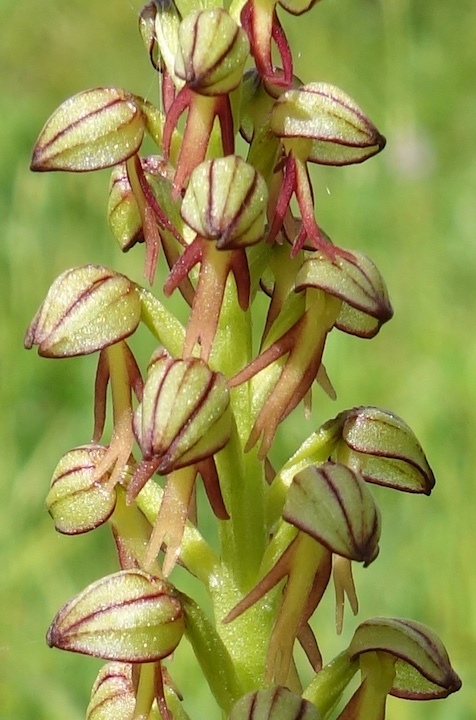
Genus: Orchis
Species: O. anthropophora
Location: Totternhoe Knolls
Dates seen: early May 2019
Identification:
- upto 40cm tall, four basal leaves
- upto 90 yellow-green flowers
- sepals and petals form tight hood, with edges of sepals a dark red
- lip shaped like a hanging human figure: two narrow side lobes form the arms, forked central lobe forming the legs
Habitat: calcareous grassland, abandonded chalk or limestone quarries
Pollination: red ants and hoverflies
UK Classification: Endangered, nationally scarce
UK Distribution: restricted mostely to Kent and Surrey
Neotinea
A very small genus containing only five species.
Burnt-tip Orchid (Neotinea ustulata)
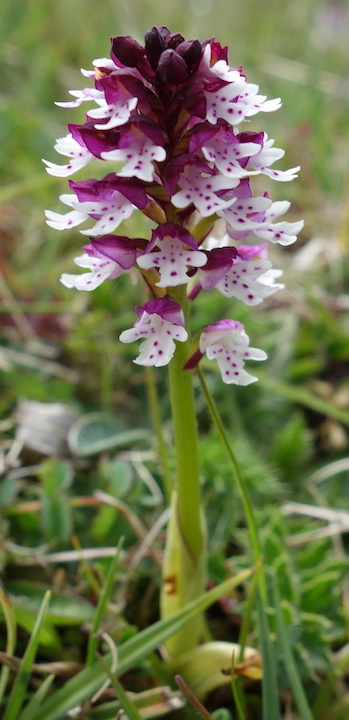
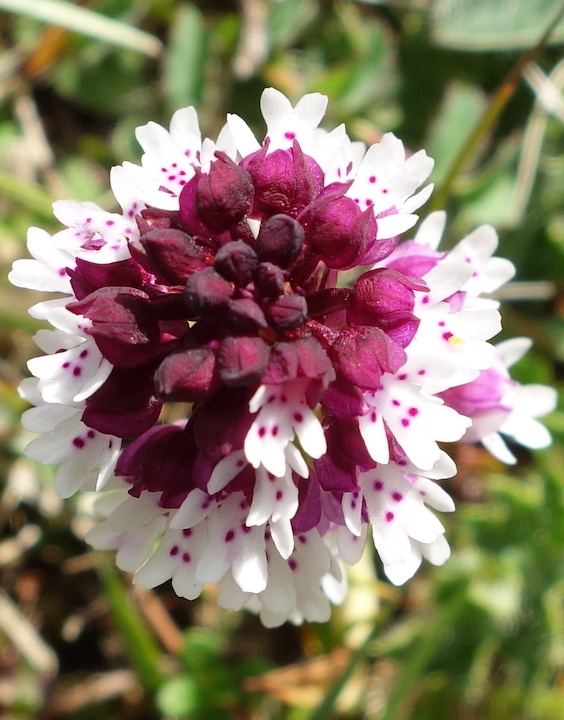
Genus: Neotinea
Species: N. ustulata (symnonym Orchis ustulata)
Location: Knocking Hoe
Dates seen: late May 2019
Identification:
- small, upto 10cm tall. Basal rosette of broad leaves
- 15 to 50 small densley packed flowers
- sepals and petals form a tight hood that is dark red-brown
- lip is white, two rounded side lobes, forked central lobe marked with crimson spots
- sweetly scented flowers
Habitat: unimproved chalk and limestone grassland
Pollination: flys have been observed as pollinators. Plants take 15 years to reach flowering maturity
UK Classification: Endangered, nationally scarce
UK Distribution: south east England
Platanthera
The genus comprises approximately 100 species. The type species is Platanthera bifolia, the Lesser Butterfly orchid. All species are distributed amongst the temperate regions of the Northern hemisphere.
Greater Butterfly Orchid (Platanthera chlorantha)
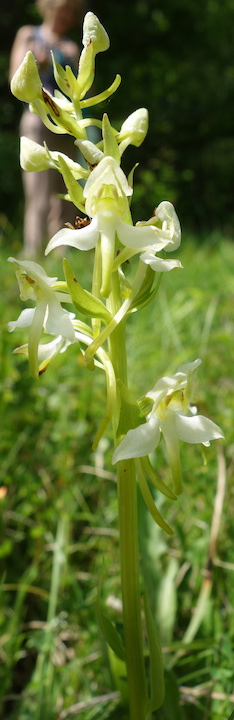
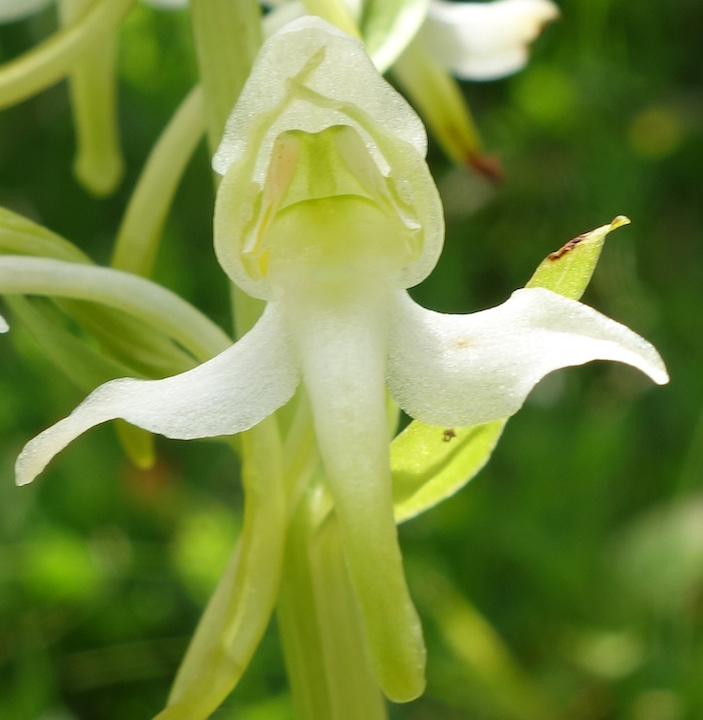
Genus: Platanthera
Species: P. chlorantha
Location: Homefield Woods, Warburg NR, Bald Hill
Dates seen: late May 2019
Identification:
- upto 60cm tall, two large elliptical basal leaves
- 10 to 40 white-green flowers
- ovate lateral sepals spread outwards, upper sepal and petals form a loose hood above the pollinia
- translucent lip is long with greenish tip
- the two pollinia diverge - in the lesser butterly orchid they are parallel
Habitat: well drained chalk grassland
Pollination: Silver-Y moth, Elephant and Small Elephant Hawk moths
UK Classification: Near Threatened
UK Distribution: Wales, England and western Scotland
Lesser Butterfly Orchid (Platanthera bifolia)
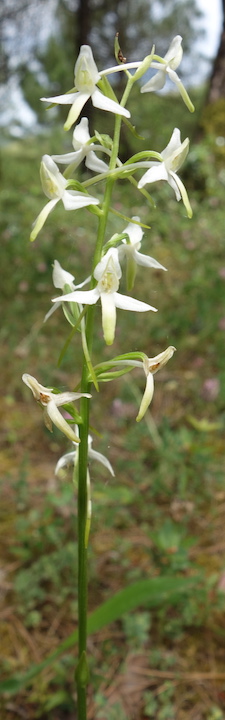
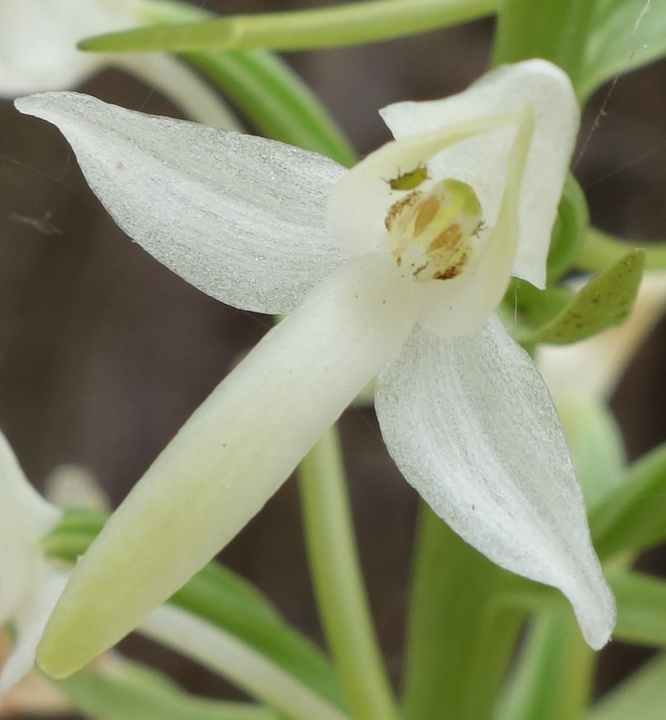
Genus: Platanthera
Species: P. biofolia
Location: Picos de Europa
Dates seen: early June 2019
Identification:
- upto 55cm tall, two large elliptical basal leaves
- upto 25 white flowers, sometimes tinged yellow-green
- in contrast to the Greater Butterfly orchid, the pollinia lie parallel and close together
Habitat: sand dunes, more acid tollerant than the Greater Butterly orchid
Pollination: Sphingid moths, as well as Small Elephant and Elephant Hawk moths
UK Classification: Vulnerable
UK Distribution: west side of Britain, as far north as Orkney
Serapias
This genus is relatively small at 15 species, but seems to hybridise very easily.
Heart-flowered Orchid (Serapias cordigera)
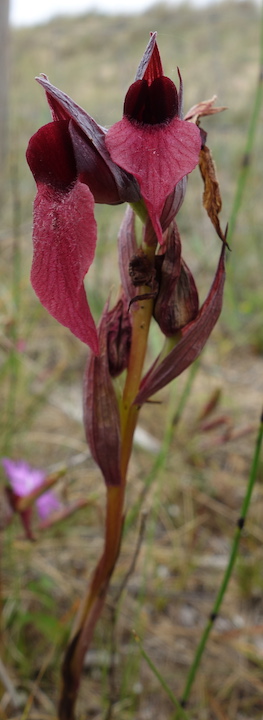
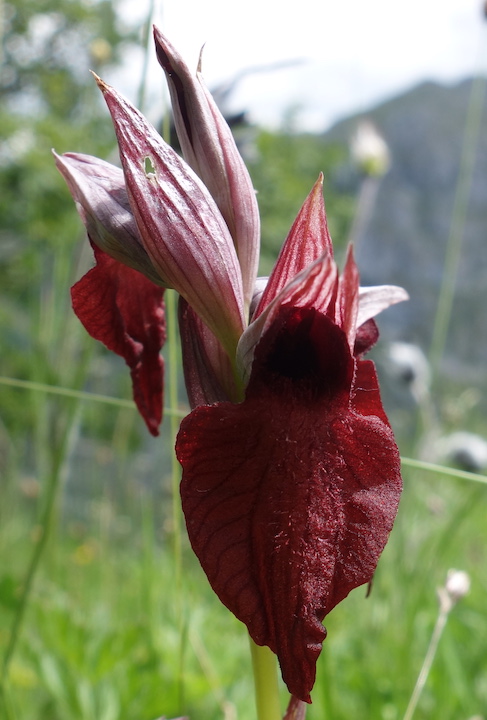
Genus: Serapias
Species: S. cordigera
Location: Picos de Europa (Liencres)
Dates seen: early June 2019
Identification:
- upto 40cm tall, bracts wide and purple tinged
- 3 to ten flowers, very dark red
- elongate hairy labellum, heart shaped central lobe
- rounded lateral lobes, emerging from hood
Habitat: full sun, acid soils (seen on sand dunes)
Pollination: no data
UK Classification: NA
UK Distribution: recorded once in Kent.
Tongue Orchid (Serapias linuga)
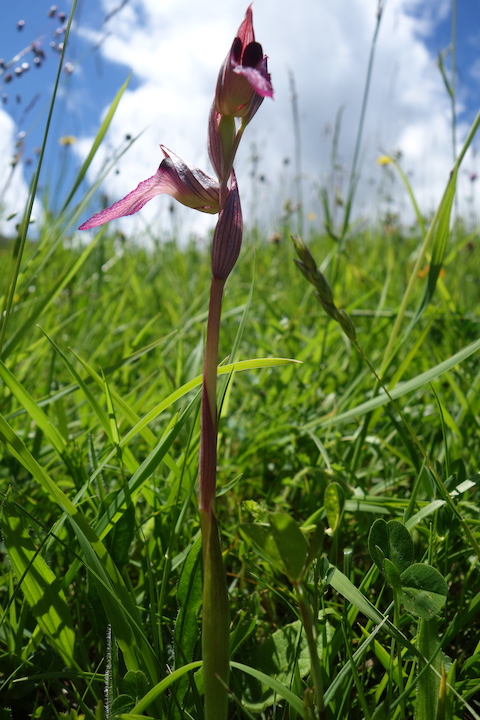
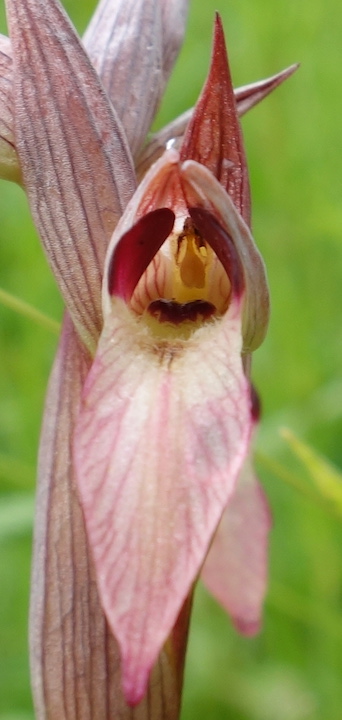
Genus: Serapias
Species: S. lingua
Location: Picos de Europa
Dates seen: early June 2019
Identification:
- upto 30cm tall, bracts shorter than hood
- two to six flowers, pale violet, horizontal hood with violet-purple veins
- labellum long (upto 3cm) , fleshy pink and hairy
- lateral lobes dark purple and concealed within hood
- pollinia greenish yellow, coffee bean swelling at base of labellum
Habitat: meadows
Pollination: no data
UK Classification: NA
UK Distribution: NA
Serapias x ambigua
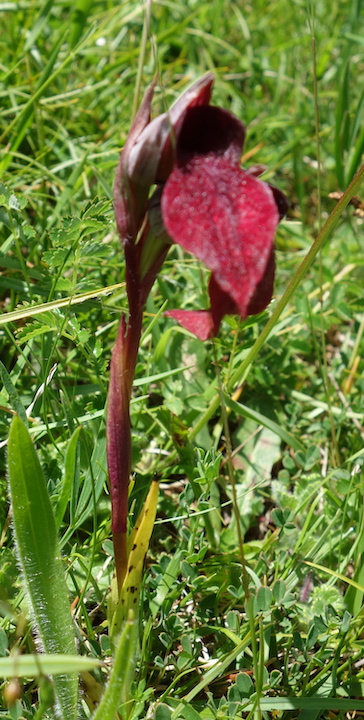
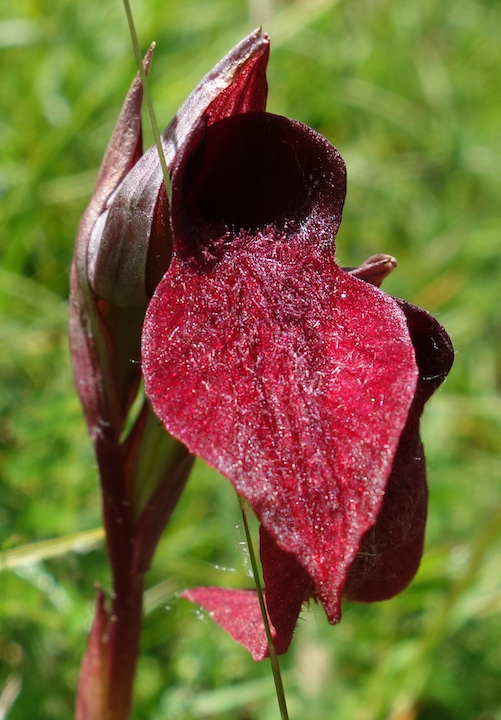
Genus: Serapias
Species: S. x ambigua
Location: Picos de Europa
Dates seen: early June 2019
Identification:
- as per heart-flowered, but no ridge on labellum
- labellum very hairy, dark plum red
Habitat: unimproved meadows, south facing
Pollination: no data
UK Classification: NA
UK Distribution: NA
References
Wikipedia entry on the Orchidaceae
Orchids of Britain & Europe - Pierre Delforge
Britain’s Orchids - David Lang
Vascular Plant Red Data List for Great Britain
Acknowledgements
I would like to acknowledge the help and knowledge of Teresa Farino for her help in locating species in and around the Picos de Europa in northern Spain. Also Dr Andrew Lack for his help in indentification of the Marsh Orchids.